Welcome to Orime!
Choose your theme
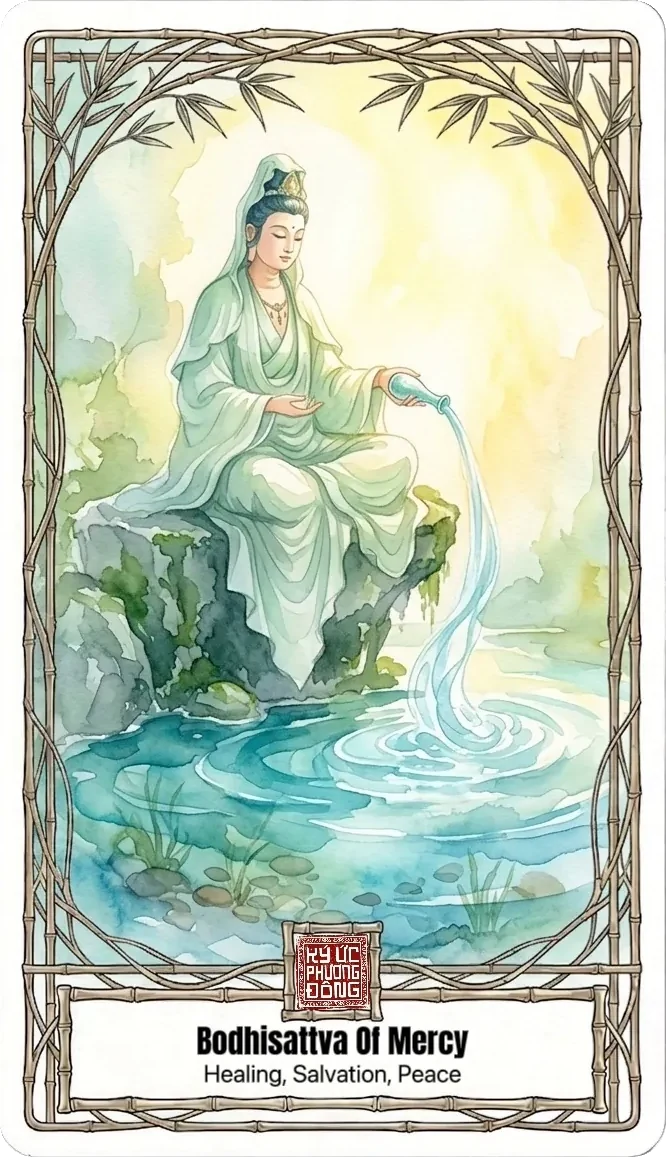
Bodhisattva Of Mercy
“She hears every cry in the world at once — and turns to answer all of them.”
| Vietnamese | Quán Thế Âm Bồ Tát |
|---|---|
| Kind | Gods & Guardians |
| In the deck | 1 of 90 cards |
The Story
There is a being who refused the finish line. The story goes that she stood at the very threshold of enlightenment, the long journey behind her, the open peace of nirvana waiting one step ahead — and then she heard it. From below, from the whole turning world, a sound rose up. It was the sound of everyone suffering at the same time: the sick and the frightened, the grieving and the lost, sailors in storms and children alone in the dark. And rather than step through the door and leave them, she turned back. That is Quán Thế Âm (literally "the one who perceives the sounds of the world"), the Bodhisattva of Mercy.
Her name is a promise about how she helps. She doesn't wait for clean prayers or the right words. She listens for the sound of suffering itself, wherever it cries out, and she goes to it. The old image is of someone so attuned that she could hear a single weeping voice the way you might hear your own name across a crowded room. In Vietnamese homes she is loved almost like a mother — gentle, endlessly patient, the one you can come to at your worst and not be turned away.
She is usually pictured with two small things in her hands, and both matter. In one hand, a slim vase of pure water; in the other, a willow branch. With the willow she sprinkles that water out over the world, and the water is said to cool every fire we light inside ourselves — the heat of greed that always wants more, the burn of anger, the fog of delusion that keeps us mistaking shadows for monsters. It is a soft, almost domestic kind of power: not lightning, just clean water on a fever.
Behind her tenderness sits a famously bracing idea, the heart of the Heart Sutra she is bound to: "Form is emptiness, emptiness is form." It sounds like a riddle, and it is meant to. What it points at is this — the things that crush us, the failures and slights and fears, are not as solid as they feel in the middle of the night. They rise, they hold us for a while, and they pass, like foam thrown up by a wave and then gone. To see that clearly is not to stop caring. It is to stop drowning.
So her mercy and her wisdom are really one gesture. She comforts you like a mother, and in the same breath she shows you that the wall you have been beating your fists against was built by your own mind — and can come down the same way, the moment you set your prejudices and your wanting on the ground and walk away from them. That, the tradition says, is where real freedom hides: not in getting everything you grasp for, but in loosening the grip.
Her closing line keeps the willow and the water: the branch scatters sweet dew, and a quiet mind reflects the shade of the Bodhi tree as plainly as still water reflects the sky. When your own heart grows that wide and that forgiving — wide as the ocean — even your sharpest sorrows lose their edge and slip back into the horizon like sea foam.