Welcome to Orime!
Choose your theme
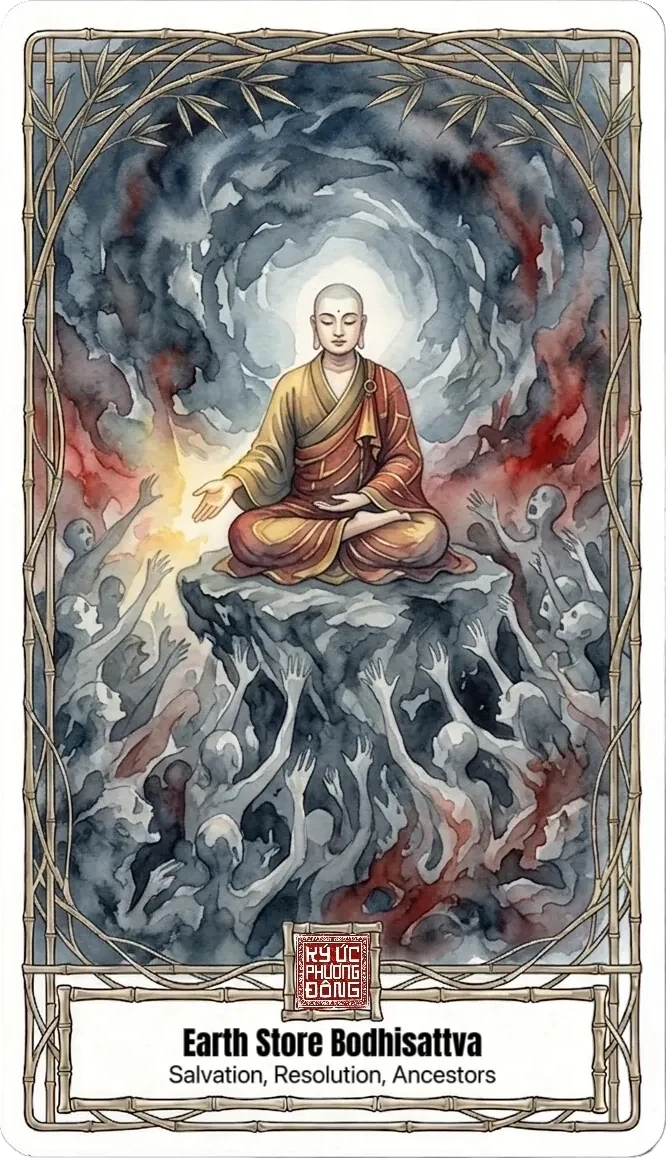
Earth Store Bodhisattva
“A prince who stood at the gates of hell and refused to leave until the last suffering soul walked free.”
| Vietnamese | Địa Tạng Vương Bồ Tát |
|---|---|
| Kind | Gods & Guardians |
| In the deck | 1 of 90 cards |
The Story
Long ago, the story goes, there was a young woman of pure heart whose mother had died believing in nothing — mocking the holy, eating cruelly, living for herself alone. When the mother passed, the daughter feared what waited for her below. So she sold everything she owned, made offerings in the mother's name, and prayed with all her strength to know where her mother's soul had gone.
In answer, the daughter found herself carried in a vision to the edge of the underworld — a shore of dark water, cliffs of iron, and beyond them the cries of the suffering. A guardian spirit met her there and told her the truth: because of the daughter's devotion and the good she had done, her mother had already been lifted out of torment and into peace. Many others had risen with her, freed by the same act of love.
The daughter could have turned back then, comforted. Instead she looked out at the multitude still trapped in the dark — souls with no children to pray for them, no one to remember their names — and something in her broke open. She made a vow that would echo across the centuries: she would not rest, would not claim her own enlightenment, until every last one of them was led into the light.
That vow is why we remember her as Địa Tạng Vương Bồ Tát — the Earth Store Bodhisattva, the Bodhisattva of the Earth Treasury. "Earth" is the whole meaning of him: patient, unmoving, vast enough to hold all things and bury all sorrow until it turns to wisdom. Like the ground beneath our feet, he asks for nothing and carries everything.
He is the one being, the tellers say, who chose the underworld for his home. While other enlightened ones ascend to radiant paradises, Địa Tạng walks the gray roads of the dead, a staff in one hand to rattle open the locked gates of hell, a bright jewel in the other to throw light into the deepest pits. Wherever a soul is lost, he goes to find it.
His promise is the one every grieving family clings to: "Until the hells are empty, I will not become a Buddha." It is a staggering thing to say. It means he will be the last to cross over — that he holds the door for everyone else and steps through only when no one is left behind. And so the living light incense for their ancestors and speak his name, trusting that no soul in his keeping is ever truly abandoned, and that mercy reaches even the places no light should reach.
To this day, when a death visits a home, it is Địa Tạng who is called on — not to judge the departed, but to walk beside them through the dark and bring them home.