Welcome to Orime!
Choose your theme
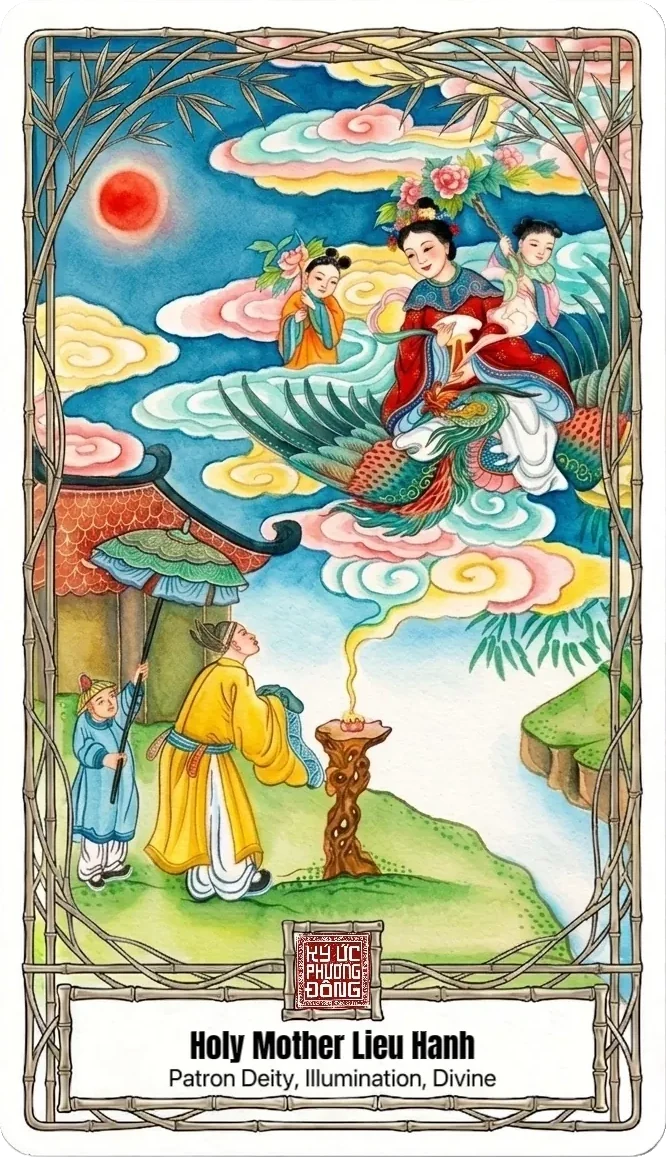
Holy Mother Lieu Hanh
“A king who ruled an entire nation knelt before her — and that, more than any throne, is the measure of her power.”
| Vietnamese | Vua Lê Kiều Mẫu Liễu |
|---|---|
| Kind | Gods & Guardians |
| In the deck | 1 of 90 cards |
The Story
Picture the throne room of a Vietnamese emperor: lacquered columns, the smell of incense, courtiers with their faces to the floor. The man on the dais holds the fate of millions in his hands. No one in the kingdom stands above him. And yet here he is, this supreme monarch — King Lê — bowing his own head, lowering his own gaze, before a woman seated in light. She is Thánh Mẫu Liễu Hạnh, the Holy Mother Liễu Hạnh, and the painting that captures this moment has been treasured for centuries precisely because of that bow.
Think about what it means. If the most powerful man alive sets down his crown and kneels, then her power must run deeper than crowns — deeper than armies, taxes, or the borders of any country. The old painters understood this. They placed the king below the Mother not to shame him, but to teach a quiet lesson: worldly authority, however vast, is a small thing beside a love that has no edges.
Liễu Hạnh is one of the most beloved figures in all of Vietnamese spiritual life. She belongs to the Tứ bất tử — the "Four Immortals," the four deathless ones who, in the Vietnamese imagination, never truly leave the world. And she stands at the very heart of the Mother Goddess tradition, the worship of the Mẫu, where the divine is pictured not as a stern father in the sky but as a mother: fierce in her protection, endless in her tenderness, always reachable by a child in trouble.
She is the mother of everyone. That is the whole of it. The lost, the frightened, the ones who have run out of road — folk belief holds that they can turn to her and be gathered in. Her compassion is described as boundless, her power as the kind that softens suffering and turns danger aside. People do not pray to her to be impressed by her; they pray to her to be held.
The painting itself — the one this card is drawn from — was no mere decoration. For generations it has been carried by respected spirit mediums into the ritual of hầu đồng, the ceremony of spirit possession, and set in the highest, most honored place in the room. There it served as an invitation: a way of asking the supreme Mother to be present, to witness, to lend her grace to what unfolds. To hang that image was to open a door.
And so a king's bow became a teaching that ordinary people repeat to themselves in hard seasons. If emperors find shelter in the Mother's shade, the reasoning goes, why should we hesitate to do the same? There is no rank too high to need her, and none too low to be welcomed. The closing words handed down with her name say it plainly: the Mother reigns over the world, and her virtue knows no bound — every sincere plea reaches her, every sorrow is soothed.
She is not a deity who lives far away on a distant peak. The tradition insists she lives much closer than that — inside the heart of every devoted child, near enough to feel. The throne in the painting is only borrowed. Her true seat is wherever someone bows their head with a sincere heart and asks to be guided home.