Welcome to Orime!
Choose your theme
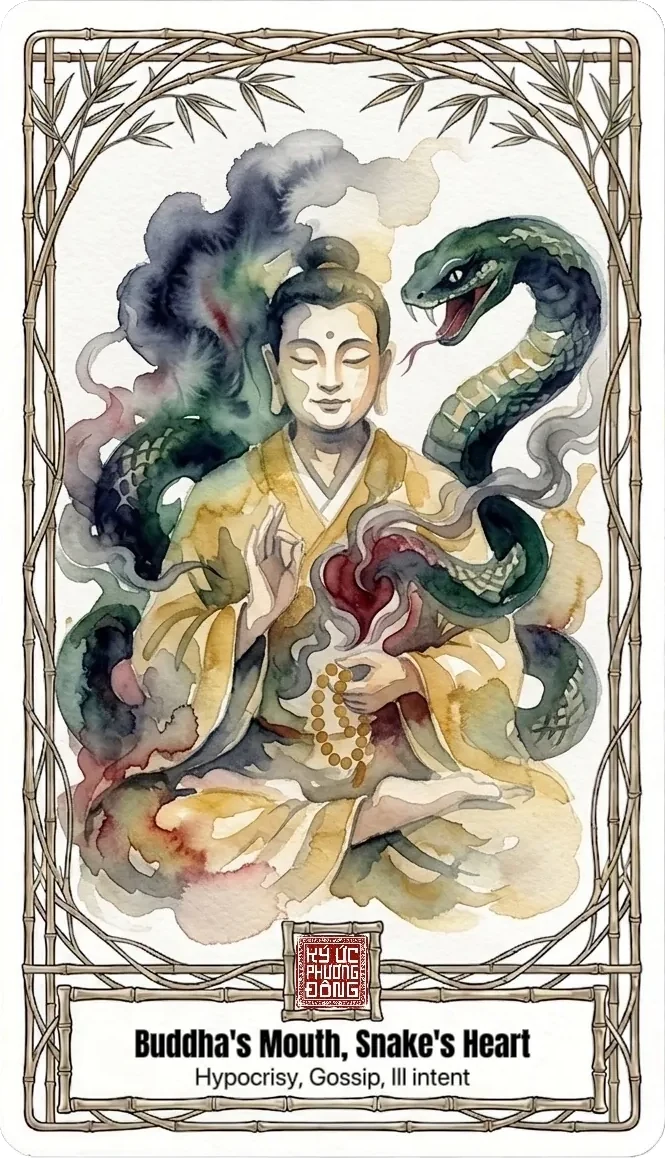
Buddha's Mouth & Snake's Heart
“A mouth full of golden prayers, a heart coiled with snake venom — the oldest disguise in the world.”
| Vietnamese | Khẩu Phật Tâm Xà |
|---|---|
| Kind | Proverbs & Fables |
| In the deck | 1 of 90 cards |
The Story
Picture the kindest face you know. The soft eyes, the gentle voice, the words that arrive like warm honey: I only want what's best for you. Now imagine that behind that face, in the quiet dark where no one can see, a snake is waiting — patient, cold, certain of its moment. That is the whole of Khẩu Phật Tâm Xà, "Buddha's Mouth, Snake's Heart." Four little words that name the most dangerous person in any room: the one who blesses you to your face and sharpens a blade behind your back.
The phrase comes from old Buddhist soil, where the Buddha's mouth stood for the highest speech a human being could offer — gentle, true, healing, free of poison. To speak with a "Buddha's mouth" was the gold standard of a good heart. So the genius of the idiom is the cruel twist it stitches on: take that holiest of images and pair it with a serpent's heart, and you've drawn the perfect portrait of a hypocrite. The outside is a temple. The inside is a nest.
Every culture has met this person. The Vietnamese have a sharper line for them still: miệng nam mô, bụng một bồ dao găm — "chanting prayers with the lips, a whole basket of daggers in the belly." You can almost see it: someone bowed in worship, palms pressed together, murmuring something holy — and stacked behind the ribs, hidden under the robe, a basketful of little knives. The horror isn't the knives. It's that the prayer and the knives belong to the same person, in the same breath.
What makes this kind of person so deadly is precisely that they never raise their voice. An open enemy you can guard against; you see the fist coming. But the snake-hearted friend works in soft tones and sympathetic nods. They remember your birthday. They ask, so tenderly, how things are going with the thing you're worried about — and then they carry that worry out the door and feed it, carefully, to exactly the wrong ears. The rumor that ruins you doesn't sound like an attack. It sounds like concern.
There's a folk saying that lives right beside this card: mật ngọt chết ruồi — "sweet honey kills the flies." The honey isn't cruel. That's the point. It's sweet, it's inviting, the fly comes willingly, and only when its wings are stuck does it understand. The smile that undoes you is the same. By the time you feel the trap, you're already in it, and the smiling face is already turned toward its next guest, gentle as ever.
And here is the oldest wisdom the idiom hands down, plain and unkillable: judge people by what they do, not by what they say. Words are cheap and easy to perfume. Actions cost something, and what they cost reveals the heart. The Buddha's mouth can be borrowed by anyone. The snake's heart shows itself only in the deed — in the favor that quietly fails to arrive, the secret that quietly travels, the kindness that always, somehow, leaves you worse off.
So the card raises a finger to its lips and tells you to watch. Not everyone who blesses you means it. Some of the warmest words in your life are wrapping paper around something cold.