Welcome to Orime!
Choose your theme
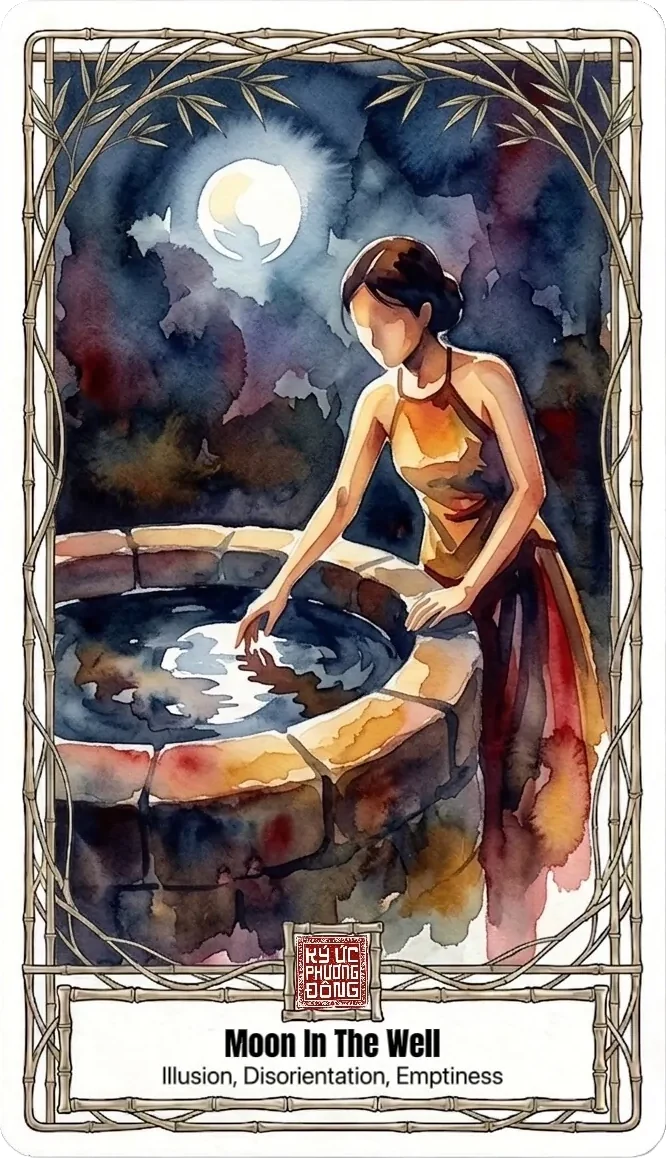
Moon In The Well
“A girl reaches into an old well to gather the full moon in her hands — and grasps only cold, breaking water.”
| Vietnamese | Trăng Nơi Đáy Giếng |
|---|---|
| Kind | Proverbs & Fables |
| In the deck | 1 of 90 cards |
The Story
It is late, and the courtyard is quiet. A girl crosses the stones to the old well, the kind every village keeps — a ring of mossy brick, a darkness that smells of rain and stone. She leans over the lip to draw water, and there, far down at the bottom, she finds the moon.
Not a sliver of it. The whole moon, round and silver and perfect, floating on the black water as if it had fallen out of the sky and come to rest just for her. She has seen the moon a thousand nights above the rooftops, small and far away. But this one is close. This one she could touch.
So she reaches. She stretches her arm down into the cool of the well, her fingers spread, certain that this time she can hold a thing that has always belonged to the heavens. Her hand breaks the surface — and the moon shatters. It scatters into a hundred trembling shards of light, slips between her fingers, and is gone. She lifts her hand out dripping, empty. Nothing but water runs from her palm.
And here is the part she almost misses, the part the whole story turns on. While she was bent over the well chasing a reflection, the real moon hung overhead the entire time — bright, whole, and utterly out of her reach. The moon in the well was never the moon at all. It was a picture of the moon, beautiful precisely because it lay so close, painted on a surface that could not hold its own shape for even a heartbeat.
This is where the Vietnamese saying lives: Trăng nơi đáy giếng — "the moon at the bottom of the well." People say it of someone who has fixed their longing on something that looks real and feels within reach but has no substance underneath. The tragedy in the phrase is gentle and very human. The girl is not foolish. The reflection genuinely is lovely. The water genuinely does shimmer. The trick is not that the illusion is ugly — it is that the illusion is fair enough to be mistaken for the truth.
And there is a quieter wisdom folded inside it, too. Why does she scoop at the well instead of simply looking up? Because the false moon is near, and the true moon is far. We often choose the version of a thing we can put our hands on over the version that is real but distant. We know, somewhere, that the water cannot hold light. We reach anyway, because reaching feels like having.
The breaking is not cruelty. It is the lesson. The cold splash, the empty hand, the ripples spreading out — that shock is the moment of waking. Only once she lets the reflection go, accepts that her hands will stay empty, can she lift her eyes and finally see the real moon shining where it always was: above her, whole, and waiting.