Welcome to Orime!
Choose your theme
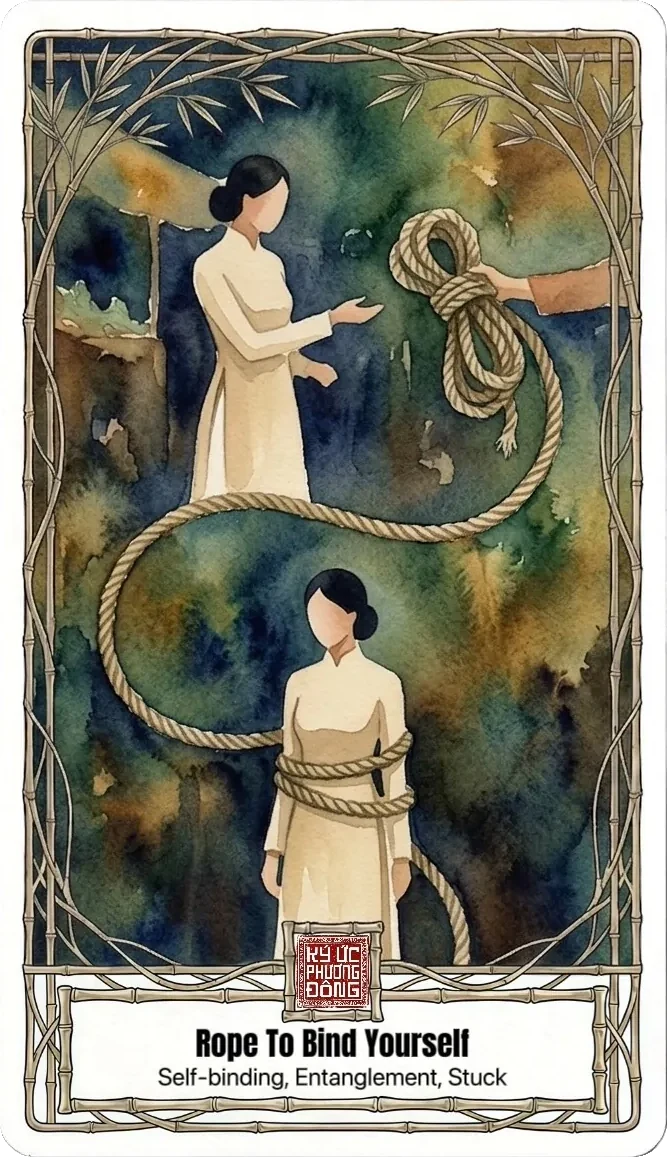
Rope To Bind Yourself
“A man walks to market, buys a length of good rope, comes home — and ties his own hands and feet with it.”
| Vietnamese | Mua Dây Buộc Mình |
|---|---|
| Kind | Proverbs & Fables |
| In the deck | 1 of 90 cards |
The Story
Picture a man at the market, coin in hand. He passes the rice and the fish and the bolts of cloth, and what does he choose? A long, sturdy length of rope. He pays good money for it, carries it home pleased with himself, and then — here is the joke that Vietnamese grandparents have told for generations — he sits down and uses that very rope to bind his own hands and feet.
Nobody forced the rope on him. No bandit ambushed him on the road, no creditor came knocking. He went looking for the thing that would trap him. He bought it. He brought it home. That is the whole picture behind the saying "Mua Dây Buộc Mình" — "to buy rope to bind yourself." It is the perfect, almost unbearable image of a person manufacturing their own prison when the door was wide open and they were free to walk out.
And once you start watching for him, you see this man everywhere. He is the friend who can't say no, so he volunteers for a fourth committee and then can't sleep. He is the cousin who signs his name to a contract he didn't read closely, charmed by the smile across the table, and spends three years tangled in the small print. He is the colleague who meddles in a quarrel that was never his, who steps between two arguing neighbors and walks away wearing both their resentments.
Notice how the rope always seems like a good idea in the moment. The market-man wasn't being foolish, exactly — rope is useful, rope is strong, more is surely better than less. That is the trap inside the trap. The saying knows that we rarely bind ourselves out of stupidity. We do it out of enthusiasm that runs ahead of our strength, out of a flash of greed that whispers grab more, or out of pride that wants to look bigger and busier and more important than we are.
The Vietnamese have a companion saying that follows close behind this one, like the second half of a breath: "He who tied the bell must untie it." It is not a cruel line. It is, oddly, a hopeful one. If a stranger had tied you up, you would have to wait and pray for a rescuer. But you tied these knots. Your own fingers wove them. Which means your own fingers — and only yours — know exactly how to pull them loose.
So the story doesn't end with the man slumped on the floor, trussed and regretful. It ends with the quiet, hard moment of clarity when he looks down at the rope, recognizes his own handiwork, and reaches for the first knot. No magic. No outside hero. Just the courage to admit, this is mine, and the patience to undo what eager hands tied too fast.