Welcome to Orime!
Choose your theme
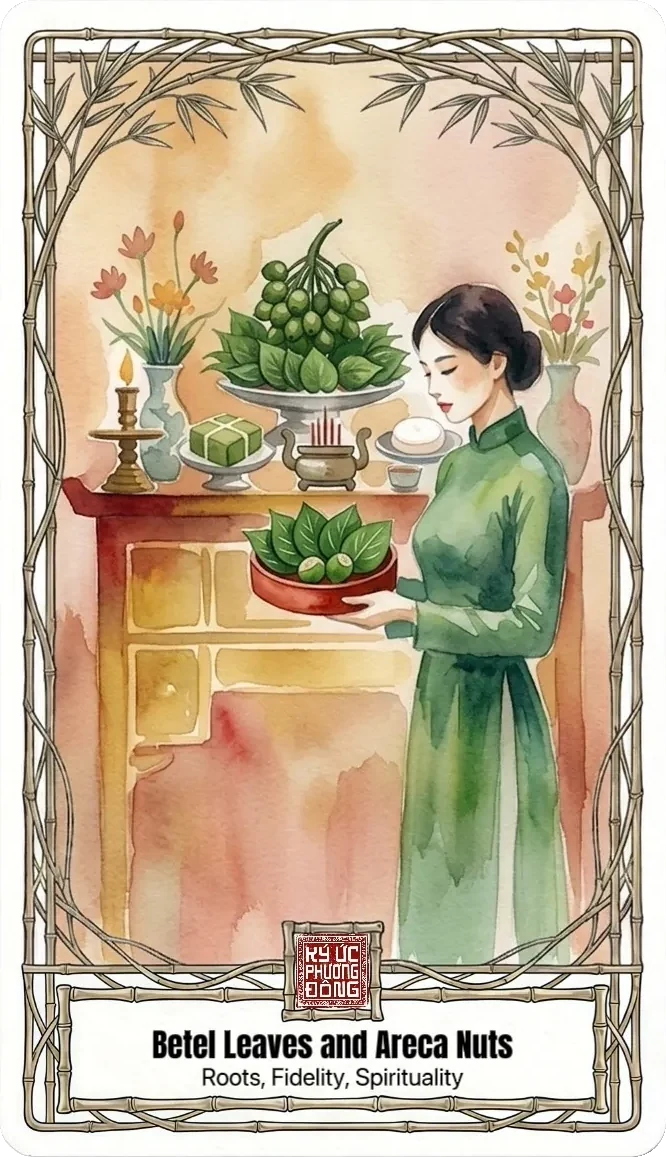
Betel Leaves and Areca Nuts
“Two brothers so alike that even a wife could not tell them apart — and the love that turned all three to stone and tree.”
| Vietnamese | Trầu Cau |
|---|---|
| Kind | Legends & Myths |
| In the deck | 1 of 90 cards |
The Story
Once there were two brothers, born so close in age and so alike in face that neighbors mixed them up at every turn. They grew up like a single shadow split in two — eating from the same bowl, sleeping under the same roof, finishing each other's sentences. When their parents died, the brothers refused to part. The elder went to study with a learned teacher, and the younger followed him there, unwilling to spend even a day apart.
At the teacher's house lived a daughter, gentle and clear-eyed. She noticed the two young men and felt drawn to one of them — but which? They looked identical. So she devised a small test. One evening she brought out a single bowl of rice porridge with a single pair of chopsticks, and watched to see who would eat first. The younger brother, ever deferring, pushed the bowl toward the elder. That was how she knew which was the elder, and it was the elder she married.
After the wedding the elder brother brought his wife home, and the three lived together as before. But something had shifted. The elder's heart was now turned toward his wife, and the younger — who had never in his life been second to anyone in his brother's affection — began to feel a coldness he could not name. He grew quiet. He ached. And one day, unable to bear the loneliness, he walked out of the house and kept walking, into the wild country, telling no one.
He walked until a wide river stopped him. There, exhausted and heartbroken, he sat down on the bank and wept until he could weep no more — and in his grief he died, and his body turned into a tall, pale stone at the water's edge.
When the younger brother did not return, the elder was seized with fear and remorse. He had let his own brother slip away. He set out to find him, following the same road to the same river — and when he reached the stone on the bank, a strange certainty came over him. He sat down beside it, laid his hand on the cold rock, and grieved for the brother he had failed. There he too died, and his body became a slender tree that grew straight up beside the stone: the areca palm.
At home the wife waited, and waited, and at last went searching for her husband. Her road led to the same river, the same stone, the same young tree leaning over it. Understanding everything in a single heartbroken glance, she sank down against the trunk and wept — and she too died, and became a vine that climbed and wound itself around the areca tree, its leaves warm and heart-shaped: the betel.
People later learned that if you take a betel leaf and a sliver of the areca nut and a smear of white lime made from that pale riverbank stone, and chew them together, the three turn a deep, living red — the color of devotion, of love that outlasts the body. The king of the day heard the tale and declared that from then on, no marriage, no greeting, no solemn promise should begin without betel and areca, so that the people would never forget how fiercely three hearts had loved.