Welcome to Orime!
Choose your theme
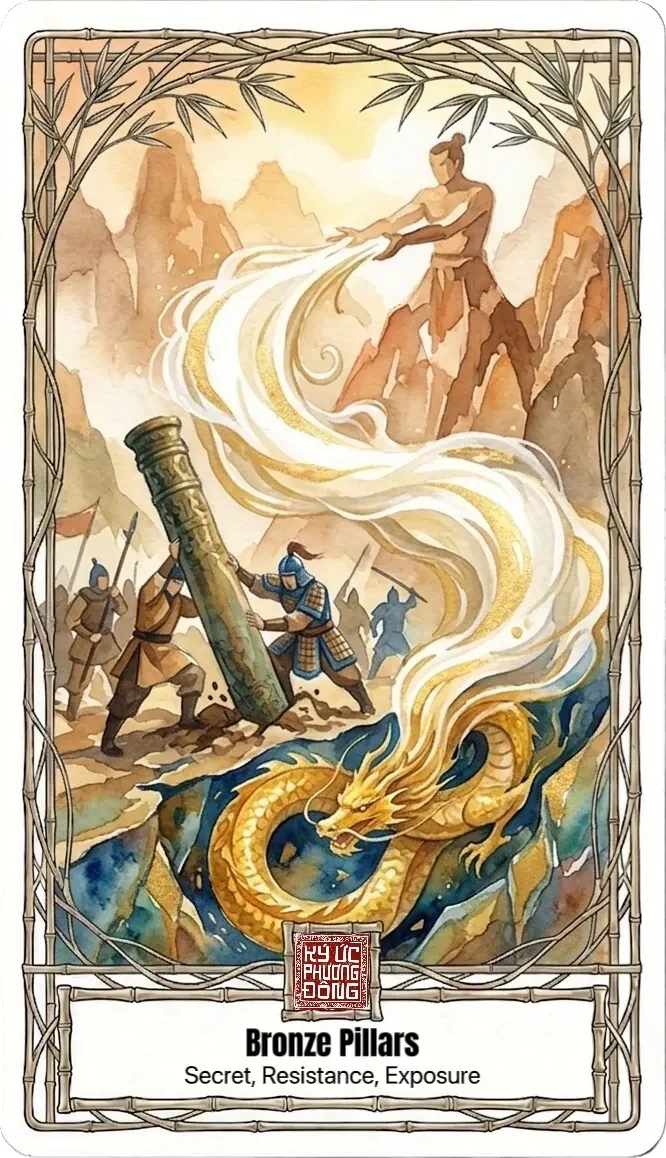
Bronze Pillars
“A conqueror drove bronze pillars into the earth to break a nation's spine — and the mountain herself moved its heart away.”
| Vietnamese | Trụ Đồng Mã Viện |
|---|---|
| Kind | Legends & Myths |
| In the deck | 1 of 90 cards |
The Story
When the last fires of the Twin Queens' rebellion had been stamped out, the foreign general Mã Viện (Ma Yuan) stood over a conquered land and was not satisfied. He had won the battle. The people still walked the same paths, sang the same songs, prayed at the same village shrines. He could feel something in the soil he could not touch — a current, a pulse, the secret life that made these people who they were. And he meant to kill it.
The old people of Việt called it the long mạch — the dragon veins. They believed the land itself was alive, that rivers and ridgelines carried a hidden flow of power the way a body carries blood, and that wherever those veins ran strongest, heroes would keep rising and a nation would keep coming back no matter how often it was struck down. Mã Viện had heard the same belief, and he was a practical man. If a country's strength lived in its veins, then he would simply cut them.
So he cast great pillars of bronze, tall and cold, and had them sunk deep into the ground at the places his geomancers marked — driven down like nails through the dragon's spine, pinning the land flat. And over them he laid a curse, a dark sentence meant to seal the wound: as long as these pillars stood, Việt would never rise again. Then he turned his horse for home, certain he had buried a country alive.
But the land was not unguarded. High on the sacred peak of Tản Viên lived a power older than any general — and the spirit known as the Mountain God's Bride, the lady of Tản Viên Sơn (Tản Viên Mountain), saw the bronze sunk into the living earth and the malice braided around it. She did not pull the pillars out. She did not break them. She did something the conqueror's mind could never have guessed: she took hold of the dragon veins themselves and quietly moved them.
Like a mother lifting a sleeping child from a cold room to a warm one, she shifted the whole hidden current of the nation's life to a new course, far from the buried bronze. By the time the magic settled, the pillars pinned nothing at all. They held down dead ground. The curse, so carefully aimed, closed its jaws on empty earth — and dissolved like smoke off a morning field.
The bronze stayed where it was sunk, slowly greening with rust, season after season, year after year. The general's scheme rotted in the dark beside it. And the land kept breathing. New heroes kept being born. The songs went on. Whatever Mã Viện thought he had nailed shut had simply gotten up and walked away while he wasn't looking — because you cannot drive a stake through a living thing's soul and expect it to lie still.
That is the strange comfort buried in this card: the conqueror had every advantage of force, and still he lost. He could command men and metal, but he could not command the sacred. Thin cloth, the old saying goes, cannot hide the eyes of heaven — and no curse, however deep, can hold down a spirit that knows how to move.