Welcome to Orime!
Choose your theme
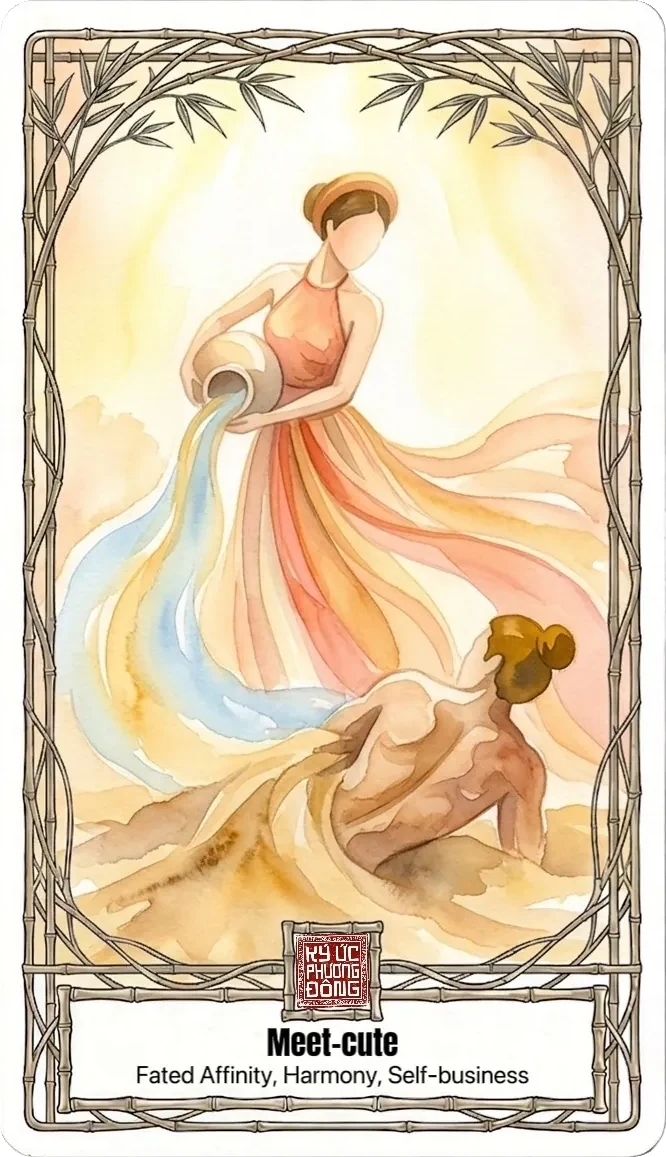
Meet-cute
“A princess pitches her bath-screen on an empty beach — and uncovers a naked boy buried in the sand.”
| Vietnamese | Chử Đồng Tử & Tiên Dung |
|---|---|
| Kind | Legends & Myths |
| In the deck | 1 of 90 cards |
The Story
There was once a young man named Chử Đồng Tử (pronounced roughly "chuh dong tuh") who had nothing. He lived with his father in a fishing village on the river, and the two of them were so poor they owned a single loincloth between them. They took turns wearing it. When the father lay dying, he begged his son to keep the cloth for himself — but the boy, unable to bear sending his father into the next world bare, buried him in it and went on with nothing at all to cover himself.
After that, Chử Đồng Tử lived in the river. He waded out at night to catch fish, kept to the deep water by day, and crept ashore only to sell his catch and dart back into hiding. He had made himself a ghost of the shallows, ashamed to be seen, certain that nothing would ever change.
Now, far upriver lived Tiên Dung ("tien zoom"), the favorite daughter of a Hùng king — a princess so fond of wandering that she refused every suitor and spent her days drifting along the rivers in a fleet of bright boats. One afternoon her boats put in at a quiet stretch of shore called Tự Nhiên, which means "Nature" itself. The beach looked deserted. So her attendants strung up cloth screens by the water's edge for the princess to bathe, and by pure chance they raised them over the exact spot where Chử Đồng Tử lay buried in the sand, holding his breath, hiding the only way he knew how.
Tiên Dung stepped behind the screen and poured water over herself, and the sand washed away in dark runnels — and there, suddenly, was a man. A naked, terrified, trembling young man, exposed before a princess. He could not run. She could not look away.
But Tiên Dung did not call her guards. She listened to his story — the dying father, the shared loincloth, the years lived in the river out of shame — and something in her went still. "I had sworn never to marry," she said, "and yet here you are, uncovered before me by Heaven's own hand. This is no accident. This is meant." And on that beach called Nature, with no go-between and no dowry and no permission, the princess married the beggar.
The king was furious and disowned her. So the two of them stayed by the river and simply began to live. They opened a market on the bank, taught the local people how to trade, and sent boats out along the water to barter far and wide. The poor stretch of shore filled with merchants and noise and goods, and the couple — the princess who gave up a palace and the boy who once owned nothing — grew prosperous together. In time the old stories say the two of them rose up to Heaven, and the people honored Chử Đồng Tử ever after as one of the Tứ Bất Tử, the Four Immortals of the land.
From a buried beggar and a wandering princess, the river had made a marriage, a marketplace, and a legend that has outlasted every dynasty since.