Welcome to Orime!
Choose your theme
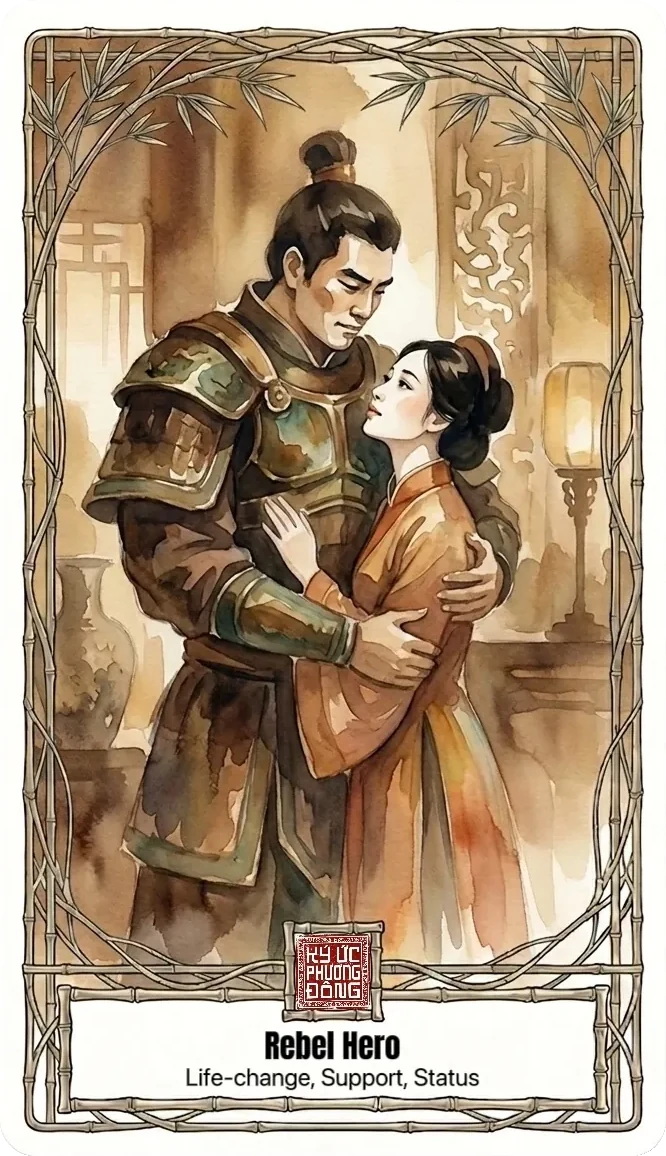
Rebel Hero
“A captive woman of the pleasure house meets a warlord who bows to her — and lifts her from the mud to a throne.”
| Vietnamese | Kiều Gặp Từ Hải |
|---|---|
| Kind | Legends & Myths |
| In the deck | 1 of 90 cards |
The Story
Of all the chapters in The Tale of Kiều — Vietnam's most beloved epic poem, the story of a brilliant, beautiful girl sold into a lifetime of misfortune — none shines like the day Thúy Kiều met Từ Hải. By then Kiều had already lost everything. To save her father from prison she had sold herself, been tricked, beaten, and traded from hand to hand until she ended up in a lầu xanh, a house of pleasure, her talent and grace worth nothing more than a price on a door.
Then a stranger walked in. Từ Hải was no ordinary customer. He was a giant of a man with a beard like a tiger's and eyes that had stared down whole armies — a rebel chief, a warlord who answered to no emperor and no law. Men trembled when he passed. He could have had anything in that house for a coin and a glance.
But when he sat across from Kiều, something happened that no one expected. He did not see a courtesan. He saw, behind the painted face, a soul as proud and unbroken as his own. Two people who had each been treated as less than human looked at one another and recognized an equal. Kiều, who had learned to expect nothing but cruelty, found herself speaking to a man who listened as if her words were worth more than his sword.
And Từ Hải acted the way heroes act in the old stories — all at once, and without flinching. He paid her ransom and bought her free. But he did not stop there. He would not keep her as a kept woman or a prize. He raised her up to stand beside him as his lady, his equal, the wife of a king-in-the-making. The girl the world had thrown away was carried out of that house in honor, and Từ Hải set the whole region at her feet so that she could finally take revenge on everyone who had wronged her. For a few golden years, talent and grace had found a mighty arm to shelter them, and Kiều was happy.
Yet the same story carries a second blade, and it falls on the hero. Từ Hải had built his power on never bowing, never trusting a softer voice than his own. When the imperial court offered terms of surrender, it was Kiều — frightened, longing for peace and a quiet life — who begged him to lay down his arms and accept the deal. Out of love, the man who had never yielded to any army yielded to her. He surrendered. And it was a trap.
Betrayed at the moment he let down his guard, Từ Hải was struck dead on the battlefield. The legend says he died standing upright, his body refusing to fall even after his life had fled — a last terrible image of a strong man undone not by a stronger enemy but by a tender word he should not have followed. The redemption that lifted Kiều from the mud was, for him, the soft counsel that cost him everything.
So the meeting of Kiều and Từ Hải is remembered as both the most glorious and the most cautionary moment in the poem: a beauty meets her champion, a hero is swayed by love, and the same fated bond saves one life while it ends another.