Welcome to Orime!
Choose your theme
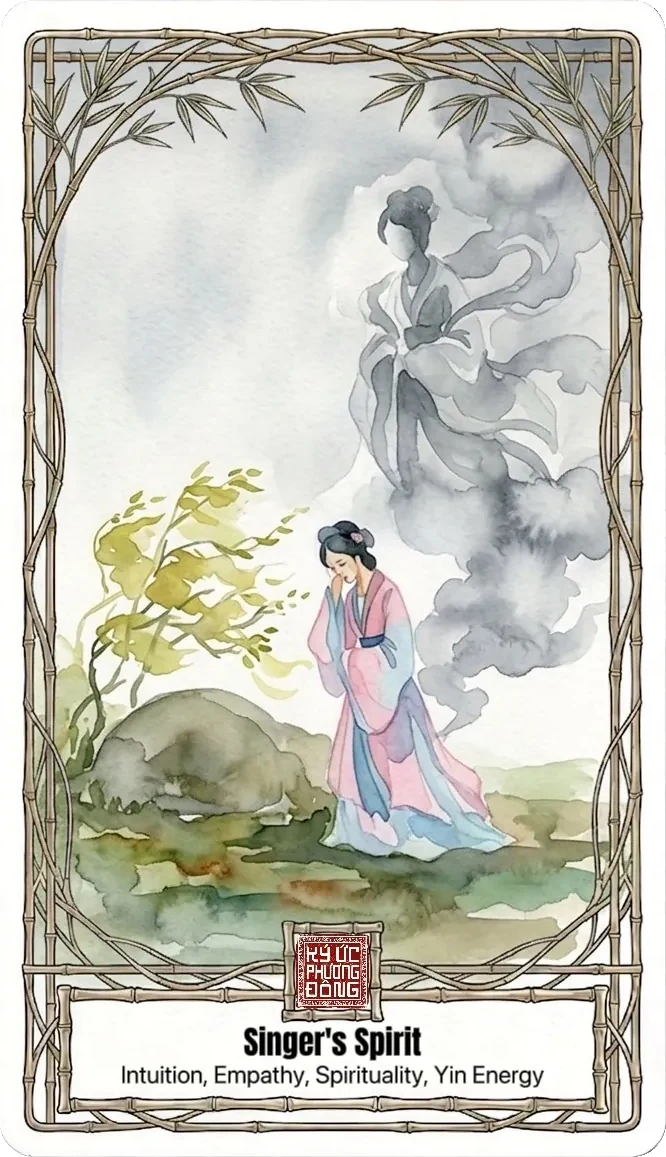
Singer’s Spirit
“On a spring festival day, a young girl weeps at the grave of a singer she never knew — and her whole fate is written.”
| Vietnamese | Kiều Thăm Mộ Đạm Tiên |
|---|---|
| Kind | Legends & Myths |
| In the deck | 1 of 90 cards |
The Story
It is the third month, the Thanh Minh festival, when families sweep the tombs of their dead and the roads fill with bright clothes and laughter. Among the crowd walks Thúy Kiều (pronounced "Twee Kyew"), a girl famous for two things: a beauty that turns heads, and a heart so tender it feels other people's sorrows as if they were her own. She has come out for the festival with her sister and brother, and the day is golden and ordinary — until she reaches a lonely stream.
There, off to the side where no one lingers, sits a small grave with no incense burning, no flowers, no name properly tended. It looks forgotten. Kiều stops. She asks who is buried there, and the answer comes in pieces: this is the tomb of Đạm Tiên (pronounced "Dam Tyen"), once a celebrated singer, a woman whose voice and face had drawn admirers from everywhere. She had been adored in her time — and then she died young, alone, with no husband and no family to mourn her, and the man who finally came to grieve arrived too late to do anything but bury her by this winding water.
Something in Kiều cannot move past it. A beautiful, gifted woman, loved by the whole world, ending nameless under a patch of weeds — the unfairness of it strikes her like a chord struck on her own instrument. While the others wait, she steps to the grave, lights a stick of incense, and lets it smoke up into the spring air. Then she weeps. Not the polite tears of a passing stranger, but real grief, as though she is mourning a sister.
Her brother teases her gently — why cry so hard for someone dead and gone? But Kiều can't explain it. She feels a thread between herself and the dead singer, an invisible line connecting them across years she never lived. Two beautiful women, two great gifts. One fate already finished in sorrow. And somewhere underneath her pity, a colder thought she doesn't say aloud: that she is looking not at a stranger's story, but at a mirror.
That night the answer comes. In a dream, Đạm Tiên herself appears to Kiều — graceful, sorrowful, kind — and speaks to her not as a stranger but as a kindred soul. The singer's spirit tells Kiều that they are sisters in fate, names written together in the same sorrowful ledger of "talent and torment." The tears Kiều shed at the grave were not wasted; they were recognition. The road the singer walked, Kiều is about to walk too.
And she does. Everything that follows in her long story — the lost love, the years sold away, the wandering and the grief — is foreshadowed in that one quiet moment by the stream, when a living girl knelt for a dead one and felt the future brush past her like cold water. The incense she lit was an act of mercy for a forgotten soul. It was also the first page of her own book turning.