Welcome to Orime!
Choose your theme
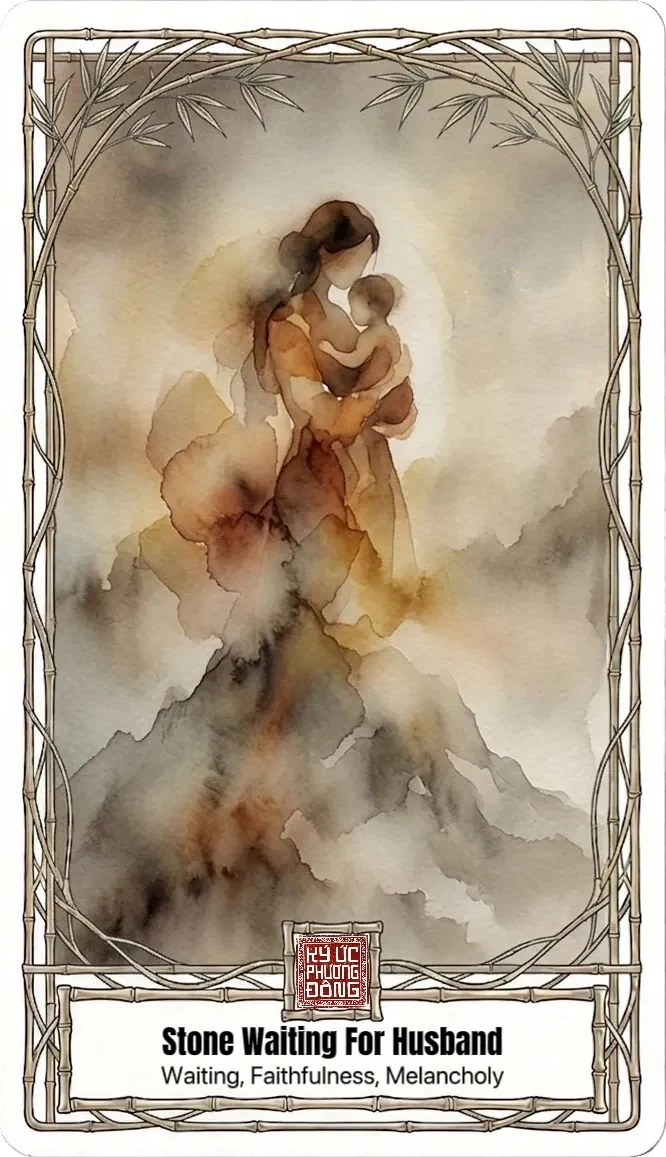
Stone Waiting For Husband
“A young mother climbs the mountain to watch the road home — and waits so long she turns to stone, child in her arms.”
| Vietnamese | Hòn Vọng Phu |
|---|---|
| Kind | Legends & Myths |
| In the deck | 1 of 90 cards |
The Story
There is a mountain in the north of Vietnam where, even now, travelers point up at a strange dark shape against the sky — the figure of a woman standing very still, a small child held to her chest. The wind tears at her, the rains come and go, the seasons turn beneath her feet, and she does not move. The people call her Hòn Vọng Phu, the Stone Waiting for Her Husband. And every grandmother who tells the story will lower her voice when she comes to the end.
Her name was Tô Thị (pronounced roughly "Toh Tee"), a young wife in a quiet village near the borderlands. She had married for love, and for a season the world was kind to her. She had a husband she adored and a baby in her arms, and the little house felt full. Then the drums of war came down the road, the way they always did in those uncertain times, and her husband was called away to fight at the distant frontier. He kissed her, promised her he would return before the child could walk, and went out the gate with the other men of the village.
So Tô Thị began to wait. At first she waited the way anyone waits — counting moons, listening for hoofbeats, asking every weary traveler who passed whether they had seen the soldiers coming home. The child learned to walk. Then to run. Then to speak, and to ask where her father was, and Tô Thị had no answer to give but "soon." The seasons stacked up like unread letters. The other wives, one by one, either welcomed their men home or wept and put away their grief and went on living. Tô Thị did neither. She could not let go.
Every day she carried her little one up the steep path to the highest rock on the mountain, the one place from which you could see the long road winding away toward the frontier. There she would stand, the child on her hip, her eyes fixed on the thin pale ribbon of road, watching for a figure that never came. She stood there in the burning sun and in the cold mountain mist. She stood through storms that bent the trees double. She would not come down until dark, and at first light she would climb again.
Year after year she kept her vigil, until her feet seemed to grow into the stone and the wind no longer moved her hair. And one day — no one knows the exact hour — the watching simply finished its work. Mother and child were turned to stone, frozen mid-gaze, still looking toward the road, still waiting. Where a living woman had stood there was now a silhouette of grey rock against the clouds, faithful past the very edge of life.
That is why, when the people of the country see that shape on the mountain, they fall a little quiet. She is the most tender and the most haunting figure in all their folklore: love so loyal it outlasted the body, a promise kept until it became part of the earth itself. And yet the story is not only praise. It is also a gentle, sorrowful warning — about a heart that gave everything to the watching, and forgot, somewhere along the way, to go on living.