Welcome to Orime!
Choose your theme
Goddess Of Autumn
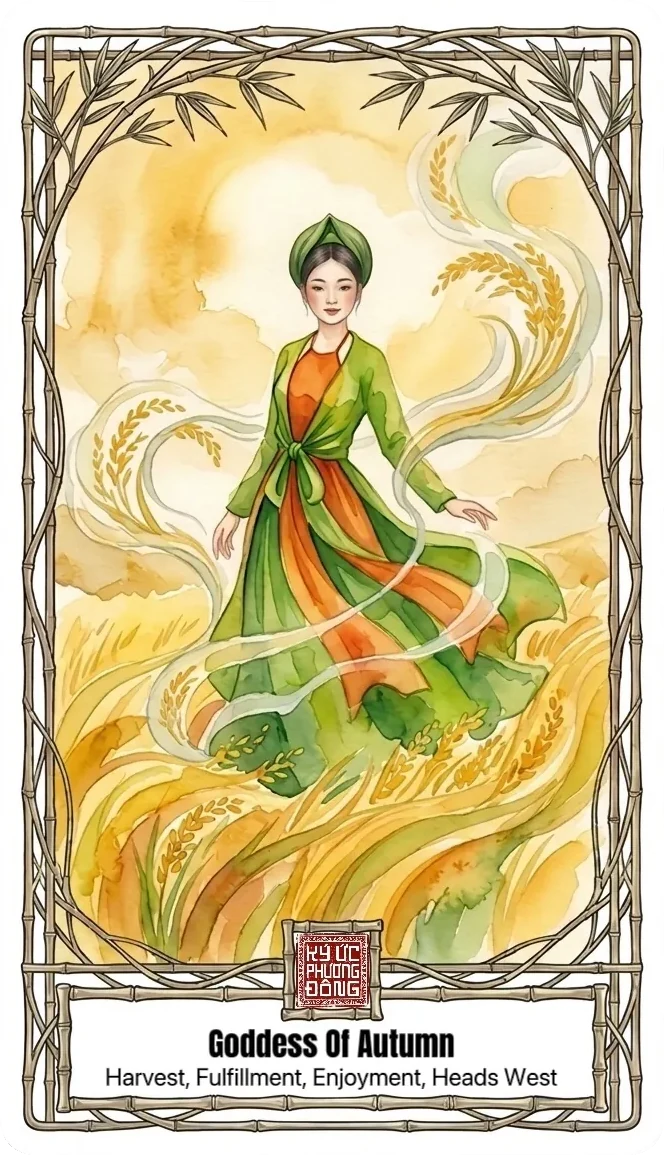
“When the rice turns gold and the sun leans west, the Goddess of Autumn walks the paddies in a raven's-beak scarf.”
| Vietnamese | Nữ Thần Mùa Thu |
|---|---|
| Kind | Traditions & Origins |
| In the deck | 1 of 90 cards |
The Story
Picture the moment the year takes its first slow breath. The blazing heat of summer has burned itself out, and over the rice fields a softer light comes down — long and amber, the kind that gilds everything it touches. Into that light steps the Nữ Thần Mùa Thu, the Goddess of Autumn, and the whole countryside seems to settle, as if it had been waiting all year just for her.
She does not arrive in a storm of power. Summer was the season for that — the dazzling sun, the green shoots straining upward, every living thing showing off. Autumn is the season of results. The goddess walks between the paddies where the rice has stopped reaching for the sky and turned instead to filling its grains, heavy and full, bending each stalk into a quiet bow. Nothing is striving anymore. Everything is becoming what it was meant to be.
She wears the dress of the women of Kinh Bắc, the old heartland of northern Vietnam: the áo tứ thân, a four-panel gown whose loose flaps move like leaves in the breeze, and on her head the khăn mỏ quạ — the raven's-beak headscarf, folded to a sharp point above the brow so that it frames the face like a dark moon. It is the headdress of a woman who has lived. There is nothing girlish about her beauty; it is seasoned and discreet, the beauty of someone who has weathered many springs and floods and knows the worth of a quiet day.
In the old way of thinking, autumn belongs to the West — to the direction where the sun goes down, and to the element of Metal: the gold of the ripe grain, the cool clarity of evening, the blade that finally cuts the harvest free. The West is where the day ends, yes, but it is also the hour when you come in from the fields to gather what the labor was for. The setting sun is not a sad thing here. It is magnificent, splendid, glorious right up until it slips below the horizon.
And so the fields are reaped. The grain that began as a single seed pressed into the mud comes home white and fragrant, and the people who planted it sit down at last to eat what their own sweat has earned. This is the deep secret of the season, the thing the goddess teaches without ever raising her voice: real happiness is not in the wild bloom but in the careful gathering. To cherish the golden grains you sowed yourself — that is the whole of it.
Yet she carries a warning in her gentle face. Autumn is a pause, not a permanent home. It sits between summer's fire and winter's long stillness, and a wise heart enjoys the harvest without forgetting that the cold is coming and the barns must be filled. She cautions, too, against the melancholy that this beautiful, dying light can stir — the autumn sadness that, indulged too long, leaches the color out of everything and leaves you mournful in the middle of plenty. Savor the season. Do not drown in it.
When her work is done, she lingers a while in the western glow, watching the smoke rise from the cooking fires, listening to the threshing songs. Then the light goes amber, then rose, then grey, and the Goddess of Autumn steps back into the dusk, leaving behind a land at peace with itself — full, grateful, and ready to rest.