Welcome to Orime!
Choose your theme
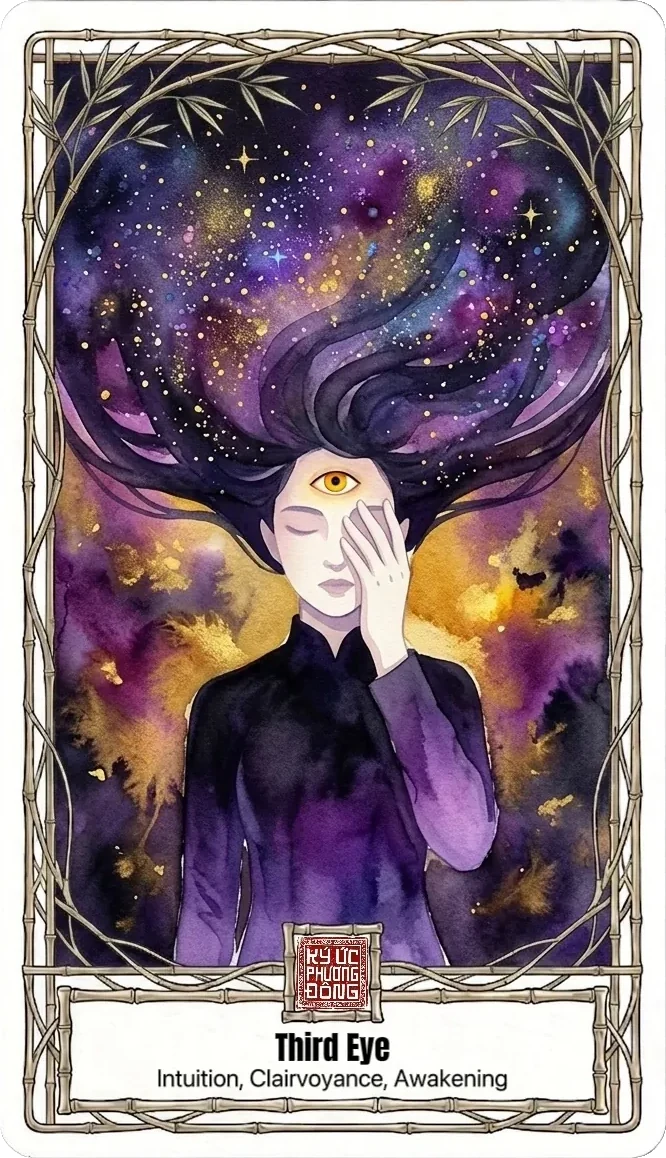
Third Eye
“Between the brows sits a quiet eye that opens only when the other two learn to close.”
| Vietnamese | Thiên Nhãn |
|---|---|
| Kind | Traditions & Origins |
| In the deck | 1 of 90 cards |
The Story
Long before anyone mapped the body's hidden currents, the old teachers noticed something simple: the people who saw the most were rarely the ones staring hardest. A hunter who could find water in a dry land. A grandmother who knew a storm was coming while the sky was still blue. A child who walked into a room and went straight to the one person carrying grief. They were not looking with their eyes. They were looking with something that had no eyelid at all.
Across the traditions of the East, that something was given a place and a name. The Vietnamese called it Thiên Nhãn, the Heaven Eye — a single seeing point set in the middle of the forehead, just above and between the two ordinary eyes. In the temples of India it became the ajna, the brow center where attention pools like rainwater in a stone basin. Different countries, different tongues, but the same stubborn idea: that human beings come with a third way of looking, and most of us go our whole lives without ever switching it on.
The traditional teaching about how to wake it is almost a riddle. Close the mortal eye, the elders said, and open the spiritual eye. They did not mean blind yourself. They meant stop trusting the surface of things so completely. The two eyes you were born with are wonderful liars — they show you the painted mask, the polished word, the smile worn for the occasion, and they tell you that is the whole of the matter. The third eye is the one that sees behind the mask without being rude enough to mention it.
So the seekers learned to sit still. They breathed slowly until the chatter in the skull went quiet. They let the day's hundred small worries settle to the bottom like silt, and they watched the clear water that remained. And sometimes, in that stillness, a knowing would arrive that had not come through any of the ordinary doors — not through the ears, not through reasoning, not through anyone telling them. It simply was there, the way you know a face in the dark by its warmth. That, the tradition said, was the Heaven Eye blinking open for the first time.
But the old people were careful to warn the young ones, because they had watched this gift curdle in unwise hands. To see through everyone is a lonely business. When the masks come off and you find yourself reading the fear under the boasting, the loneliness under the loud laugh, the small cruelty hiding inside the kind words — you can grow bitter, and bitterness is its own kind of blindness. So the teaching always came with a companion. The third eye, they insisted, is not for judging. It is for understanding. You see deeper precisely so that you can be gentler, not so that you can be right.
And there was one last caution, the oldest of all. Do not fall so in love with the unseen world that you forget to eat, forget your family, forget the ordinary daylight where life is actually lived. The Heaven Eye is meant to help you walk the dusty road more wisely — not to lift you off it. A seer who floats above the world helps no one. The whole point of seeing further is to come home and love what is in front of you better than you did before.