Welcome to Orime!
Choose your theme
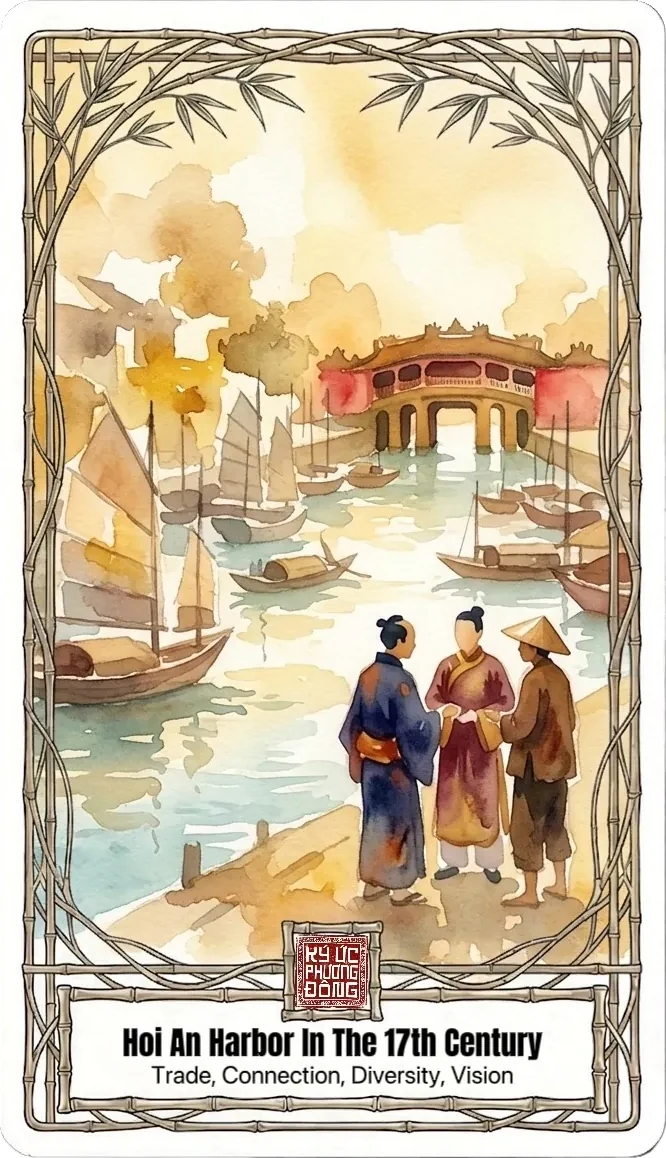
Hoi An Harbor In The 17th Century
“Four hundred years ago, the whole world docked at a single quiet river in central Vietnam — and the bargaining never stopped.”
| Vietnamese | Hội An Thế Kỷ 17 |
|---|---|
| Kind | Traditions & Origins |
| In the deck | 1 of 90 cards |
The Story
Picture a river the color of weak tea, the Hoài, sliding past a town in central Vietnam that smelled of pepper, raw silk, and salt fish drying in the sun. This was Hội An (pronounced "hoy ahn") in the seventeenth century, and on any given morning its waterfront was the busiest crossroads in all of Southeast Asia. Sails crowded the river mouth like leaves blown onto a pond — fat-bellied Chinese junks, sleek Japanese trading ships, and the high-sided vessels of Portuguese and Dutch captains who had crossed half the planet to reach this exact muddy bank.
They came for the things this coast did better than anywhere else: silk so fine it slid through a wedding ring, cinnamon and pepper, sugar, fragrant eaglewood, blue-and-white ceramics, and pearls. They came in the autumn, riding the monsoon winds inland, and they waited out the long months until the wind turned and carried them home. A trading port, in those days, was not a quick stop. It was a season of your life. And so the merchants did not merely buy and sell — they settled in.
Walk the streets and you could hear four or five languages tangled in a single conversation. The Japanese built their own quarter, complete with a small arched bridge — a covered wooden bridge that still stands today, with a little temple tucked into its side. The Chinese raised assembly halls with curling tiled roofs and altars to the patron spirits of seafarers. Vietnamese families ran the shops between them, keeping the books, brokering the deals, marrying into the foreign households until the children of the harbor were a little bit of everywhere.
What made Hội An golden was not luck — it was openness. The local lords could have slammed the gates, taxed the strangers into the sea, treated every foreign accent as a threat. Instead they swung the doors wide. They let the Japanese keep their customs and the Christians keep their churches and the Chinese keep their gods, because they understood a quiet truth that fortunes are made on: a difference is not a wall. A difference is a doorway. Where one merchant saw a strange tongue, another saw a new market on the far side of the sea.
And so wealth poured in from every direction at once — "a hundred rivers flowing into a single sea," as the old saying went. A young trader with nothing but a sharp eye and an honest reputation could, in a few good seasons, build a house with a tiled roof and a name worth trusting. The river carried profit the way it carried boats: steadily, abundantly, to anyone wise enough to keep the harbor of their heart unguarded.
It did not last forever — rivers silt up, winds and powers shift, and other ports eventually rose. But for a hundred bright years, this little Vietnamese town showed the world what happens when strangers are welcomed instead of feared. The lesson it left behind outlived the gold: prosperity follows the people who open up, who connect, who turn the whole crowded world into a partner instead of a rival.