Welcome to Orime!
Choose your theme
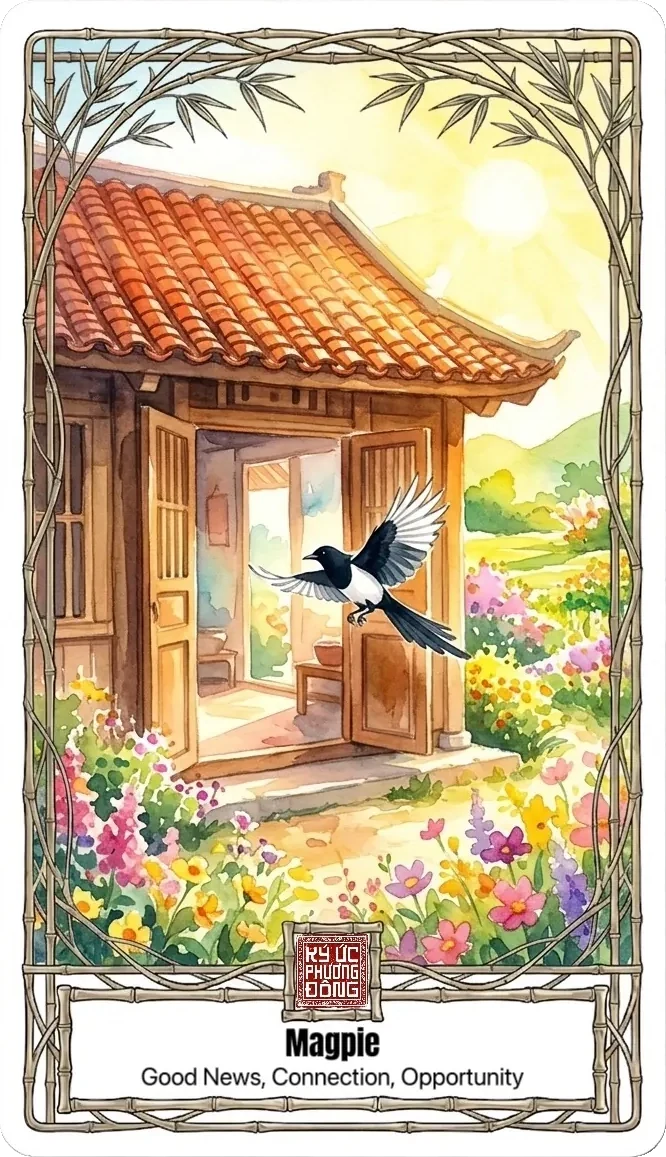
Magpie
“When the magpie sings "khách, khách" outside your window, set another place at the table — a guest is on the way.”
| Vietnamese | Chim Khách |
|---|---|
| Kind | Traditions & Origins |
| In the deck | 1 of 90 cards |
The Story
In an old Vietnamese village, the first sound of morning is not the rooster but a black-and-white bird perched on the gatepost, throwing its head back and crying out: khách, khách, khách. The word means "guest." And every grandmother in the lane will tell you the same thing — when the Chim Khách (the magpie) sings like that, you had better sweep the yard, brew fresh tea, and find your good shirt, because someone is coming.
Nobody can quite remember when people first started listening to the bird this way. It is one of those beliefs that feels older than memory, passed mouth to mouth across countless verandas. The magpie was never an ordinary creature in this telling. It was a messenger — a small winged postman flitting between houses, carrying word of who was on the road, who had remembered you, who was about to walk back into your life with their arms full.
Picture the scene the old stories love best. A wife sits alone, her husband gone for months to trade in a faraway town, the road silent for so long she has stopped watching it. Then one grey morning the magpie lands on the fence and will not stop singing — khách, khách — bright and insistent, as if scolding her for losing hope. She wipes her hands on her apron, half-laughing at herself, and starts to cook. By dusk a familiar figure rounds the bend in the lane, dusty and grinning, and she understands the bird knew before she did.
That is the magic the magpie was given: it hears the good news while it is still far off, while the letter is still in the satchel and the traveler is still days down the road. Its call is the sound of distance closing. A reunion you had given up on. A reply to a question you asked long ago. An honored visitor who arrives not empty-handed but bearing exactly the help, or the chance, or the kind word you needed most.
So the custom grew up around the bird. To hear it was a small daily blessing, and to live well you learned to deserve your guests — to keep the house ready, the kettle warm, the welcome sincere. The magpie taught hospitality without saying a word. It reminded people that good fortune so often arrives wearing the face of a stranger at the gate, and that the family who answers the door with an open heart is the one the bird sings for again and again.
There was a quieter lesson too, tucked inside the cheerful one. The magpie sings of news that is coming — not news that has arrived. The wise wife still finished her cooking; she did not run through the village announcing her husband's return before he had crossed the threshold. The bird's promise was real, but it asked for a little patience: welcome the good thing once it is truly in your hands, and let the joy be the sweeter for the waiting.