Welcome to Orime!
Choose your theme
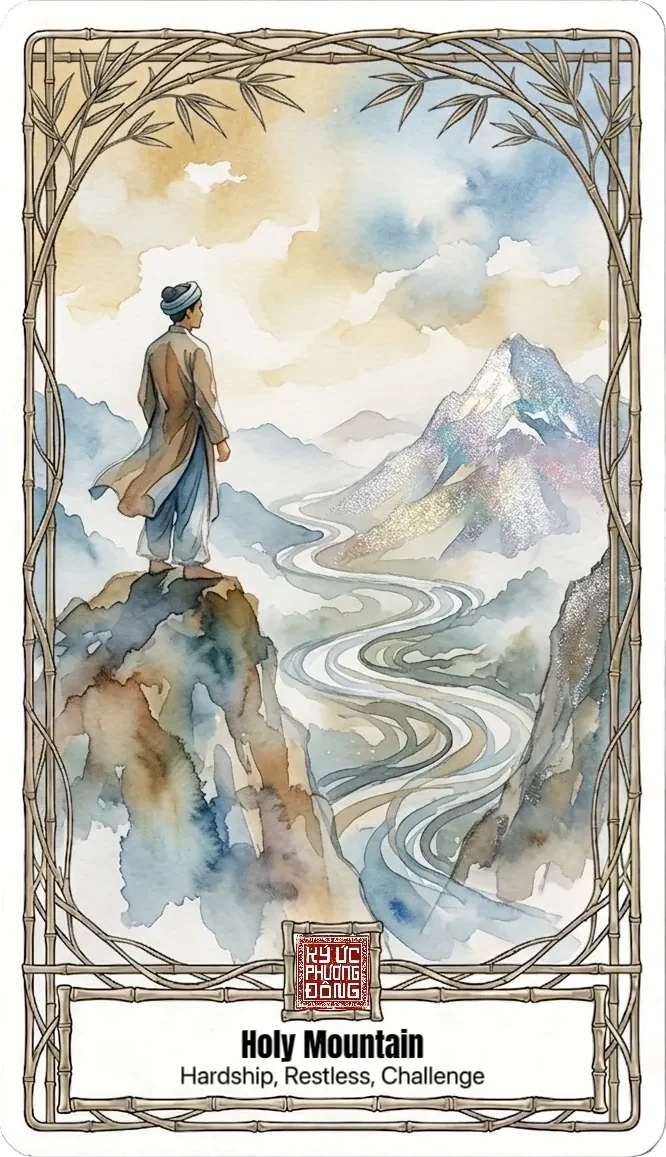
Holy Mountain
“Climb the holy mountain and you learn its oldest secret: every summit you reach reveals another, taller one behind it.”
| Vietnamese | Linh Sơn |
|---|---|
| Kind | Traditions & Origins |
| In the deck | 1 of 90 cards |
The Story
Before dawn, the pilgrim ties on a pair of worn cloth shoes, fills a gourd with water, and steps onto the path that leads up Linh Sơn — the Holy Mountain. The village below is still asleep. Up ahead, the trail vanishes into mist, and somewhere far above, hidden in cloud, waits the sacred summit where the air is said to be clean enough to wash a heart.
The first stretch is easy, almost pleasant. The path winds gently through bamboo, birds call, and the pilgrim feels strong and certain. This is nothing, he thinks. By midday I'll be standing at the top. He has not yet learned what every mountain teaches sooner or later: the easy part is always a trick the mountain plays before it begins in earnest.
Then the slope tilts. The friendly dirt path turns to loose rock that slides underfoot. Passes narrow until he must press his back to the cliff and shuffle sideways. His legs burn, his lungs heave, and at last — gasping, triumphant — he hauls himself over a ridge he has stared at for hours, sure it is the peak. He looks up. And there, looming behind it, is another mountain, higher than the first, its summit lost in the same indifferent cloud. The old saying has a name for this moment: "beyond high mountains, higher mountains rise." There is always one more.
This is the heart of the pilgrimage, and the part the villages have understood for centuries. The point was never simply to arrive. People climb Linh Sơn not because the top hands out prizes, but because the climbing itself sorts the steadfast heart from the restless one. Anyone can want the summit. Only some will keep walking when the summit keeps moving.
Halfway up, a temptation always comes. Resting on a cold rock, the pilgrim glances across the valley and sees a different peak in the distance — greener, gentler, glowing in the light. Surely that one would have been easier. Surely the view from there is finer. This is the mountain's sly whisper, the one the old people warn about: the urge to stand on one peak and gaze longingly at another, forever certain that the far hill is softer than the thorny one under your own feet. But anyone who has crossed over knows the secret — the green peak across the valley has its own loose rock, its own narrow passes, its own thorns waiting just out of sight.
So the pilgrim does the only thing the mountain respects. He stops measuring how far is left. He stops comparing his hard slope to someone else's distant green one. He simply takes the next step, and the next, paying the climb in the only currency it accepts — sweat, patience, and a heart that refuses to turn back. The shoes wear thin. The gourd runs low. And slowly, ridge by ridge, the cloud begins to thin around him.
When at last he reaches the true summit — and he does — it is not the view that has changed him. It is the climb. He arrives quieter than he left, a person who has stopped believing in shortcuts and stopped envying far-off hills, because he has finally felt in his own legs the truth the mountain was holding all along: only a steadfast heart ever reaches the shore.