Welcome to Orime!
Choose your theme
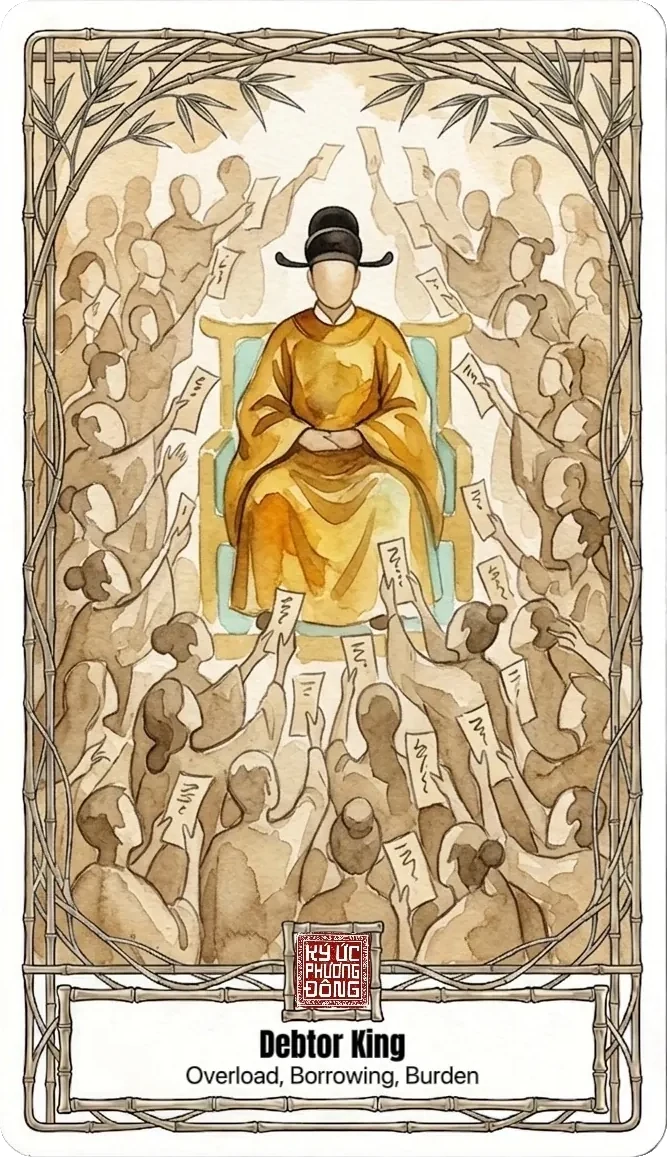
Debtor King
“A penniless young man ran up so many tavern debts that, once he became king, he simply pardoned a whole region's taxes.”
| Vietnamese | Nợ Như Chúa Chổm |
|---|---|
| Kind | Heroes & History |
| In the deck | 1 of 90 cards |
The Story
Long before he wore a crown, the man the people would one day call the Debtor King — Nợ Như Chúa Chổm — was just a poor young fellow named Ninh, drifting through the streets of Thăng Long, the old capital that is now Hanoi. He was a survivor of a fallen royal line, hiding among ordinary folk while the country churned through one dynasty's rise and another's collapse. Nobody looked at him twice. He was hungry, broke, and clever the way hungry people learn to be.
So he did what hungry young men with no coin have always done. He ate on credit. A bowl of soup here, a plate of rice there, a cup of wine when the night was cold — "put it on my tab," he'd say, and the eatery owners, charmed or just resigned, let him. There was something about him that made people trust they'd be paid back someday. Day after day the tabs piled up, scrawled on the walls and remembered in the shopkeepers' heads, until half the food sellers of the capital were quietly owed money by this ragged nobody.
Then destiny turned the page. The old royal house was restored, the rightful line called back to the throne, and the poor young man — Ninh — was the heir. He became King Lê Trang Tông. The beggar who had eaten on credit now sat in the palace, with armies and ministers bowing before him.
But debts have long memories. Word spread through Thăng Long: the young man who owed everyone money was now the king. And so they came — the noodle sellers, the rice cooks, the wine pourers — a great cheerful, hopeful crowd of creditors converging on the palace gates, each one clutching the memory of a tab the king had run up in his lean years. There were so many of them, and the old debts were so tangled and uncountable, that no royal treasury could ever sort it out coin by coin.
The king laughed at the impossibility of it. He could not pay them all back one by one — there were simply too many, and who could prove what was owed? So he found a king's solution. He issued a decree forgiving the taxes of that whole region, wiping the slate clean in one grand stroke. Call it the debt repaid in the only currency a king truly commands: not coins from a purse, but mercy from a throne. The little debts of a hungry boy became a gift to an entire people.
There is a sweeter footnote the storytellers love. Because Ninh owed so many people so much money, the saying went, nobody ever wished him dead — for a dead debtor pays nothing. His very debts kept him alive and protected, half the city silently rooting for his fortunes to rise so their own loans might be honored. His burden, it turned out, was also his shield.
And so his name passed into the Vietnamese language itself. To this day, when someone is buried in debt up to their ears, people say they owe "like Chúa Chổm" — like the Debtor King.