Welcome to Orime!
Choose your theme
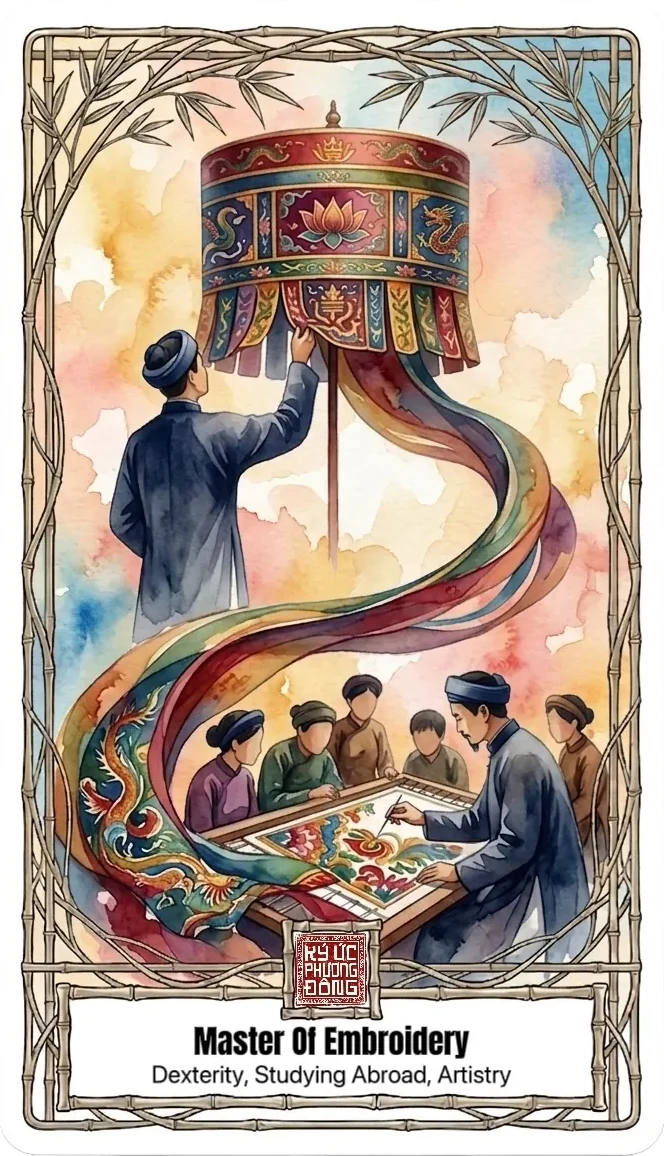
Master Of Embroidery
“A trapped envoy who climbed a tower to die, and came down knowing how to embroider an empire.”
| Vietnamese | Ông Tổ Nghề Thêu |
|---|---|
| Kind | Heroes & History |
| In the deck | 1 of 90 cards |
The Story
Long before Vietnam had embroidery guilds and silk-stitched parasols sold in every market town, it had a problem: the finest brocade, the most dazzling needlework, all of it came from the North, from China, and the secret of making it stayed firmly on the far side of the border. Then a clever official named Lê Công Hành (Le Cong Hanh) was sent abroad on a diplomatic mission — and quietly changed everything.
Lê Công Hành was the kind of man who noticed things. Where others saw a wall, he saw how the bricks were laid. Where others heard small talk, he listened for what people were trying not to say. So when his hosts in the North decided to test the visiting envoy — to see whether he was a fool or a threat — they devised a trap as elegant as it was cruel. They led him to the top of a tall tower, ushered him inside, and then took the ladder away. No stairs, no door he could reach, no way down. The message was plain: let the southern envoy sit up there and think hard about his cleverness.
Most men would have panicked, shouted, despaired. Lê Công Hành sat down and looked around. The tower was not empty. There was a Buddha statue, there were hanging banners stitched with thread, and there were two paper parasols leaning in a corner. To a desperate prisoner these were nothing. To a curious mind, they were a lesson waiting to be read.
Hungry, he discovered the Buddha statue was made of something edible — a flour cake — and so he ate, day by day, and stayed alive. Bored and patient, he took down the embroidered banners and turned them over in his hands, tracing every stitch backward until he understood exactly how the needle had gone in and come out, how the colors were layered, how a flat cloth became a field of flowers. He studied the parasols the same way, unfolding and refolding them until their ribs and joints gave up their secret. Day after day in that silent tower, he taught himself two crafts that an entire kingdom had tried to keep from him.
And then there was the matter of getting down. He had watched, on his way up, how the tower was built — and noticing is its own kind of key. By his wits he found a way to climb safely back to the ground, walking out of the trap not as a broken man but as a thief of knowledge, carrying nothing in his hands and everything in his head.
Home in Vietnam, Lê Công Hành did the thing that made him a tổ nghề — a founding master of a trade. He did not hoard what he had learned. He taught it, openly and generously, to the people of his home region, until whole villages took up the needle and the parasol-frame and made them their own. For that gift he is honored to this day as the ancestral master of embroidery, his name spoken with the gratitude a craft reserves for the one who first opened the door.