Welcome to Orime!
Choose your theme
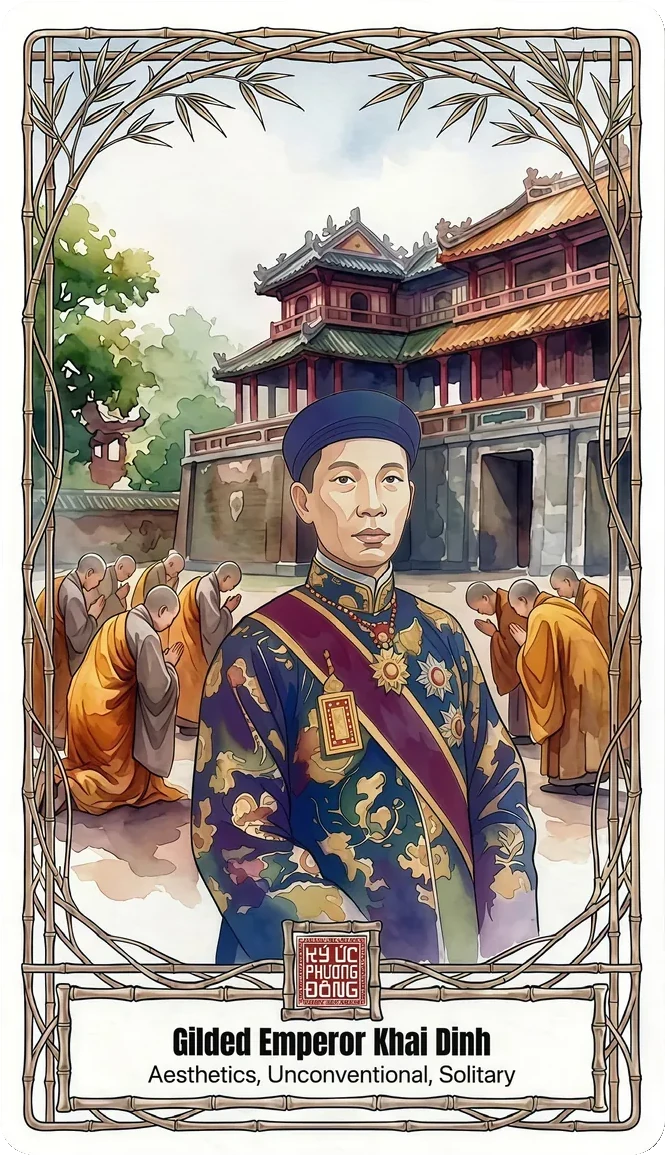
Gilded Emperor Khai Dinh
“An emperor who turned his own tomb into a jewel box, and answered a court full of offered beauties with a single cool line.”
| Vietnamese | Vua Khải Định |
|---|---|
| Kind | Heroes & History |
| In the deck | 1 of 90 cards |
The Story
Picture the Imperial City of Huế in the early 1900s — a maze of vermilion gates, lotus moats, and tiled roofs curling at the corners like waves. Through its courtyards walks Khải Định (Khải Định, the twelfth emperor of Vietnam's Nguyễn dynasty), a slight, fastidious man who notices everything: the cut of a sleeve, the glaze on a roof tile, the way light falls on a porcelain shard. Where other rulers craved armies or land, this one craved beauty. He was, before the word existed for his world, a designer.
His court did not always know what to make of him. High mandarins, eager to please, brought him gifts of the usual kind — lovely young women presented to the throne, the expected tribute to an emperor's appetite. Khải Định looked at the procession and gave an answer that has outlived almost everything else about him. "My imperial harem," he said, "is like a pagoda; whoever wishes to practice asceticism may enter." In other words: come if you like, but here you will find a monk's cell, not a lover's bed. Behind his throne, the deck pictures the quiet silhouettes of Buddhist nuns — the still, devotional life that his palace, for all its silk, more closely resembled.
So the warmth he could not find in people, he poured into objects. He restyled his own robes and crown until they became a personal fashion no one had worn before — part Vietnamese tradition, part something entirely his own. He reordered rooms, commissioned murals, fussed over color and proportion. People muttered that he was strange, vain, too taken with surfaces. He let them mutter. A man who knows exactly the self he wants to be rarely waits for permission.
His masterpiece was the most unlikely project of all: his tomb. Most emperors built mausoleums of green hills and serene ponds, in the gentle Sino-Vietnamese style. Khải Định built Ứng Lăng (the Ứng Tomb), and built it like nothing Vietnam had ever seen — dark concrete spires that looked almost European, fused with dragons and phoenixes from the old world. Inside, he had artisans cover the walls and ceilings in mosaics made from thousands of fragments of broken porcelain and colored glass, every shard set by hand until whole rooms glittered like the inside of a jewel box. He worked on it for years. He was, quite literally, designing the room where his body would rest forever.
There is something both dazzling and lonely in that. A man making his own grave beautiful is a man who has decided that beauty, not company, is what he will leave behind. The court came and went; the offered brides came and went; the politics of a country slipping under foreign control pressed in from every side. Through all of it, Khải Định kept arranging tiles, certain that art would last when affection had drifted off, out of sync, like a song played in the wrong key.
And he was right about the lasting part. The women, the gossip, the daily slights are gone. Ứng Lăng still stands above Huế, every glass shard catching the sun, a cold and gorgeous monument to a man who answered an empty heart by building something that would never fade.