Welcome to Orime!
Choose your theme
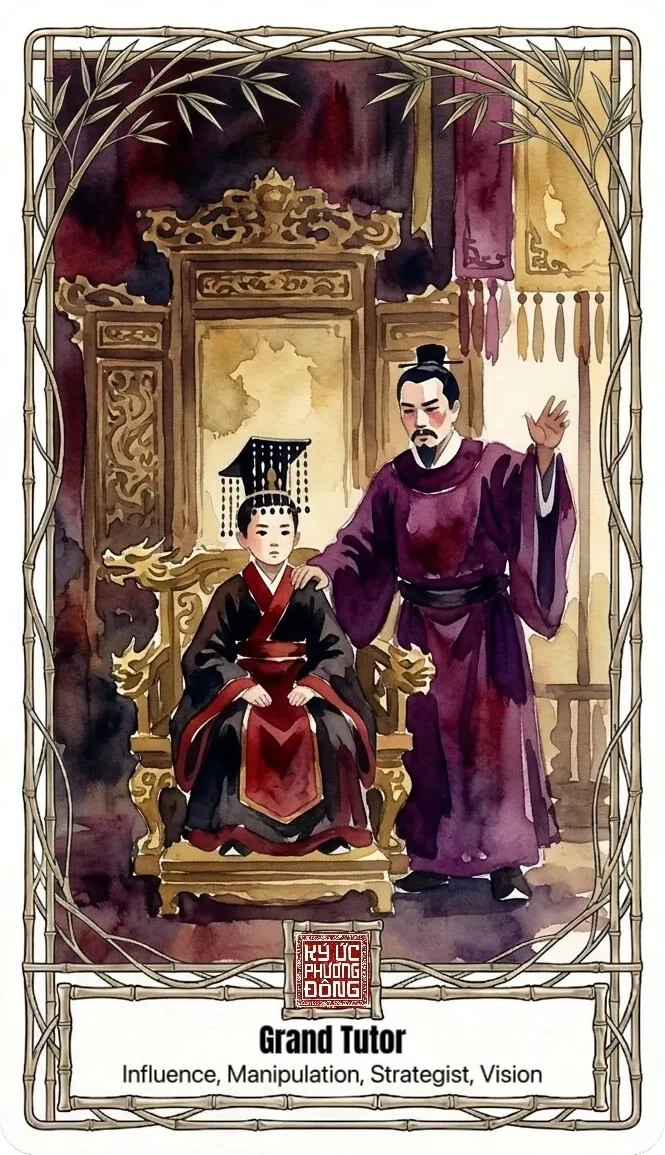
Grand Tutor
“He never wore the crown — he simply decided whose head it would sit on.”
| Vietnamese | Thái Sư Trần Thủ Độ |
|---|---|
| Kind | Heroes & History |
| In the deck | 1 of 90 cards |
The Story
In the closing years of the Lý dynasty, the throne of Đại Việt — the medieval kingdom that would become Vietnam — was held by a sick, exhausted king and, after him, by a little girl. The court was hollow, the treasury thin, the great families circling like wolves. And standing quietly behind the curtain, in a plain official's robe, was a man named Trần Thủ Độ (pronounced roughly "Chun Too Doh"). He held the title of Thái Sư — Grand Tutor, the highest minister in the land — but titles were never the point. Power was.
Trần Thủ Độ came from a clan of fishermen and river folk who had risen by their wits and their swords. He saw, with absolutely cold eyes, that the Lý line was finished. So he engineered something almost unthinkable: he arranged for the child-empress, Lý Chiêu Hoàng, the last Lý ruler, to marry his young nephew Trần Cảnh — and then, with a few careful words and a great deal of pressure, to simply hand the throne over to her new husband. In one quiet stroke, without a war, without storming a single gate, the dynasty changed hands. The Trần dynasty was born, and it would rule for nearly two hundred years.
People hated him for it, and he let them. There is a famous moment when a relative came to complain to the new king that Trần Thủ Độ held too much power, that he was the real ruler. Instead of punishing the man, Trần Thủ Độ is said to have praised him for telling the truth and rewarded him — because he understood something most powerful men never do: he did not need to be loved, and he did not need to be feared in the small, petty way. He needed the kingdom to hold together. Everything else was noise.
His methods could be ruthless. To protect the fragile new dynasty he removed rivals, bent the proud old families to his will, and arranged marriages and alliances the way a master arranges pieces on a board. He took on the bad reputation gladly, the way a man takes on a heavy coat in winter — because the alternative was chaos, and chaos kills more people than any single hard decision ever does.
And yet, when the kingdom truly needed a sword instead of a strategy, he picked it up himself. When the Mongols — the most terrifying army the world had ever seen — came pouring south, the young king's nerve wavered and he asked Trần Thủ Độ whether they should surrender. The old minister's answer became legend. "My head," he said, "has not yet hit the ground. Your Majesty need not worry about anything." They fought. They won. The man who ruled from behind the curtain had also, when it counted, guaranteed the survival of the whole nation with his own life.
He died an old man, never king, never wearing the crown he had handed to others. But every emperor of the long, brilliant Trần dynasty owed his throne to the fisherman's nephew who had decided, calmly and without sentiment, who would rule — and who would not.