Welcome to Orime!
Choose your theme
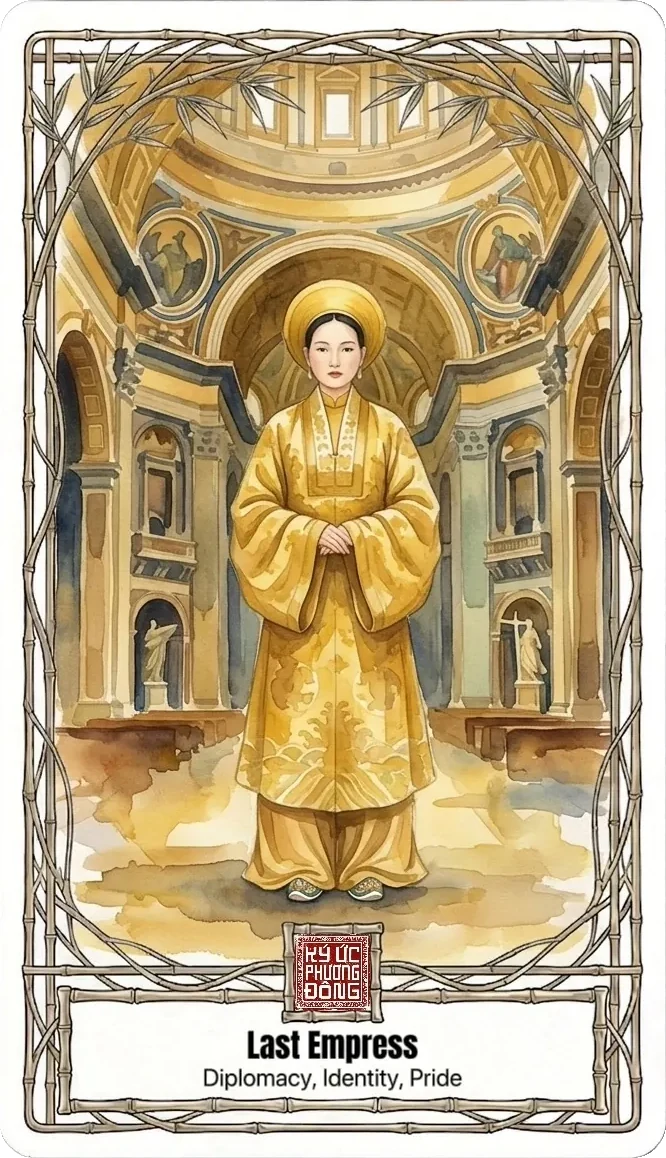
Last Empress
“The last empress of Vietnam walked into the Vatican in a Nhật Bình gown — and the whole world looked up.”
| Vietnamese | Hoàng Hậu Cuối Cùng |
|---|---|
| Kind | Heroes & History |
| In the deck | 1 of 90 cards |
The Story
In 1939, a young Vietnamese woman crossed the marble floor of the Vatican to meet the Pope. She did not arrive in Paris fashion or borrowed European silk. She came dressed in the Nhật Bình — the embroidered ceremonial robe of a Vietnamese empress, its silk crowded with phoenixes and clouds and good-luck words stitched in golden thread. Cardinals turned. Cameras flashed. And in that vast Western basilica, the most striking figure in the room was a daughter of the East who had refused, even for a day, to dress like anyone but herself.
Her name was Nam Phương — "Fragrance of the South" — and she was the last empress Vietnam would ever crown. She had grown up wealthy and convent-educated, fluent in French, equally at home with European manners and with the rituals of her own people. When she married the young Emperor Bảo Đại and stepped into the imperial court at Huế, she carried two worlds inside her and somehow let neither one swallow the other.
That was the rare gift the world noticed in her. She could move through a Paris salon or a papal audience with perfect ease — and never lose the accent of where she came from. She spoke of Vietnam to foreigners who had barely heard its name. She wore her heritage on her body like an argument no one could win against. "Integrate," her whole bearing seemed to say, "but do not dissolve."
Being empress, though, was never only glory. The court was a maze of old loyalties and quiet rivalries, and the years she lived through were brutal ones — a fading dynasty, a country pulled between empires, a throne that would not outlast her generation. Through all of it she kept a still, dignified composure that some mistook for coldness and others recognized, correctly, as strength. Behind the gentle face was a sharp and watchful mind.
Her marriage brought heartbreak; her nation brought upheaval; the throne itself dissolved beneath her. And yet the image that survived her was not defeat. It was that one luminous moment in Rome: an East Asian woman standing among the most powerful men on earth, owing them no apology, carrying her country's pride in the very cloth on her shoulders.
When people remember Nam Phương now, they don't dwell on the politics that broke around her. They remember the posture — the way a person can stand at an unfamiliar height, in a room built by strangers, and remain unmistakably, gracefully herself. That is what made her the last empress and, oddly, the most modern one: she understood that dignity is something you bring with you, not something a place hands you.