Welcome to Orime!
Choose your theme
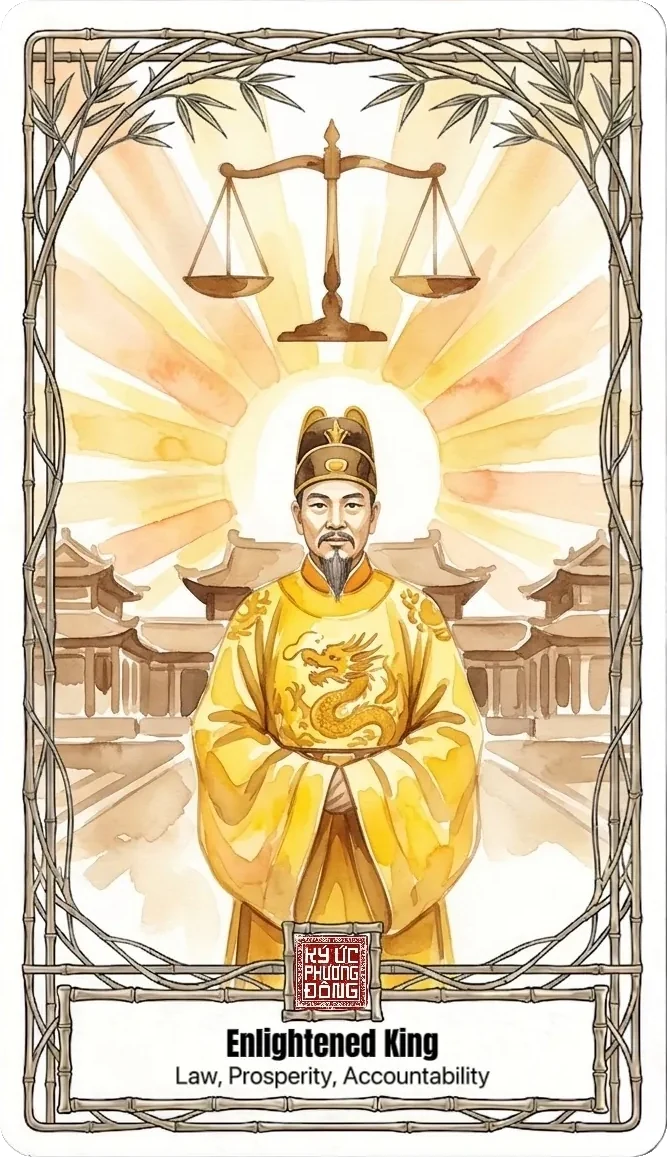
Enlightened King
“A poet-king who ruled Vietnam by the rule of law, and built a golden age on fairness instead of fear.”
| Vietnamese | Vua Lê Thánh Tông |
|---|---|
| Kind | Heroes & History |
| In the deck | 1 of 90 cards |
The Story
When Lê Thánh Tông came to the throne, Vietnam was a country that had been bruised by years of intrigue and weak rulers. He was barely eighteen, a quick-minded young man with a poet's heart, and the court watched him the way courts always watch a new king — wondering how long the gold would last before the cracks showed. They did not yet know they were looking at the man who would give his country its brightest age.
He loved learning the way some kings love war. He read late into the night, wrote poems by the hundred, and gathered scholars around him like a man planting an orchard he meant to live long enough to harvest. But the thing he is remembered for most was not a verse. It was a book of laws.
The code he built was called the Hồng Đức Code, after the name of his reign, and it was unlike anything the region had seen. Most laws of that age existed to protect the powerful and keep everyone else in line. His did something stranger and kinder: it tried to protect the people who had no one else to protect them. For the first time, the law put real rights into the hands of women — a daughter could inherit, a wife could hold property, a marriage could not simply be torn up at a husband's whim. It said, in plain legal language, that the small and the overlooked still counted.
He governed by a simple, demanding idea the old scholars called the rectification of names — that everything and everyone should sit in its proper place and do what it was truly meant to do. A judge should judge fairly. An official should serve, not steal. A king should be bound by the same scales he held over everyone else. It sounds obvious. It is one of the hardest things a person with power ever agrees to.
And that is the part of him that still amazes people. He was the most powerful man in the land, a monarch who could have ruled on a whim — and instead he set the scales of justice above his own head and stepped under them. He let the law be taller than the king. Disputes were settled by evidence and written rule, not by who shouted loudest or paid the most. A clerk's careless mistake could be answered for; so, in principle, could a courtier's.
The country he left behind was the one his people had been waiting for: orderly, prosperous, schooled, and largely at peace. Roads were safe, granaries were full, scholars flourished, and an ordinary family could go to sleep trusting that the rules would be the same in the morning. Historians have called his reign a golden age ever since — and the secret of it was almost embarrassingly plain. He did not buy that peace with cruelty or conquest. He built it out of fairness, applied patiently, to everyone, including himself.
Long after he was gone, the line was remembered: an enlightened ruler governs a peaceful era, and strict, even-handed laws bring blessings to ten thousand families. Not blessings for the king. Blessings for the families.