Welcome to Orime!
Choose your theme
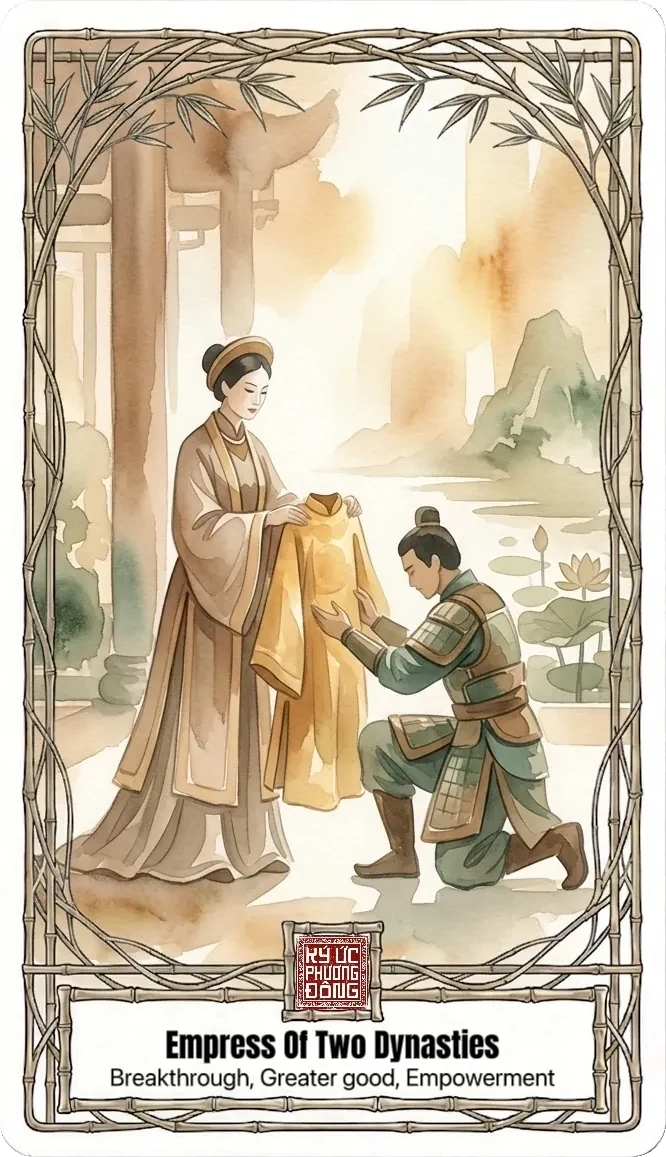
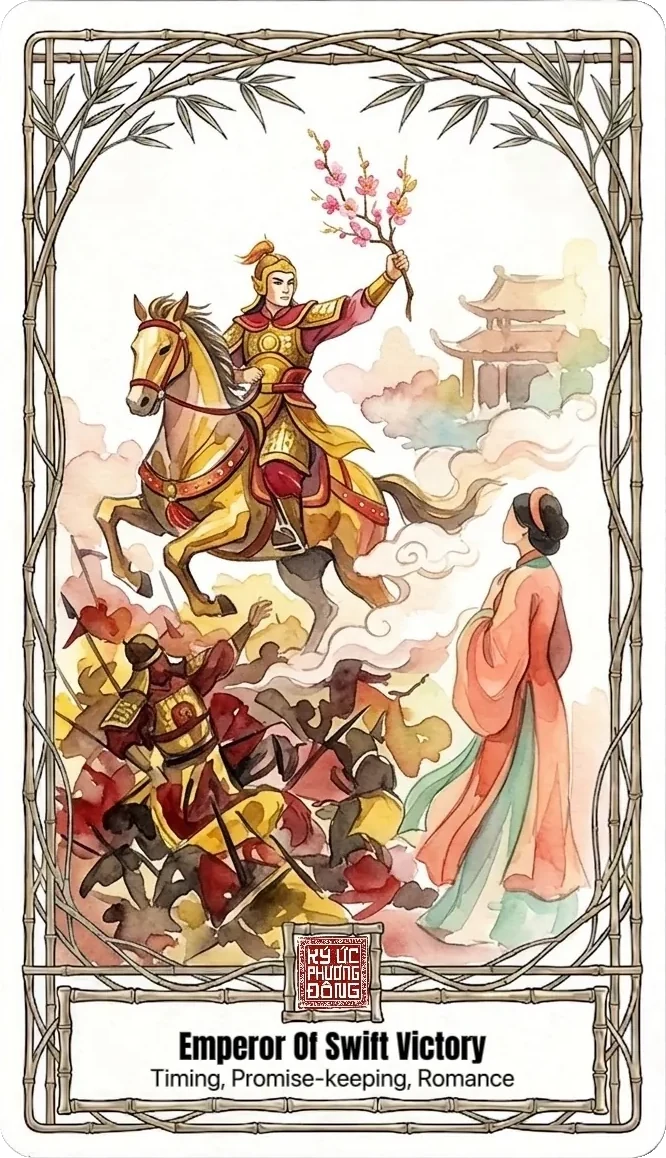
Empress Of Two Dynasties
“When invaders massed at the border, a widowed queen draped the dragon robe over her best general — and saved a nation she could not rule alone.”
| Vietnamese | Thái Hậu Dương Vân Nga |
|---|---|
| Kind | Heroes & History |
| In the deck | 1 of 90 cards |
The Story
The king was dead, and the boy on the throne was barely old enough to hold a sword. His mother, Dương Vân Nga (Duong Van Nga), sat beside him as regent — a young widow guarding a fragile new kingdom that had only just stitched itself together after centuries of foreign rule. From the north, the Song armies were already on the march. From the court around her came a softer, more poisonous sound: the whispering of men who watched a woman hold power and waited for her to fail.
She had every reason to cling to the throne for her son. Custom demanded it. The old Confucian codes a woman was raised to obey — the "three obediences and four virtues" — taught her to defer, to endure, to keep the line unbroken at any cost. To do anything else was to invite a lifetime of scorn. And yet, looking at her child and then at the war gathering beyond the walls, Dương Vân Nga did the cold arithmetic that no one else in that room dared to do.
A child king could not lead an army. The kingdom did not need a symbol; it needed a soldier who could win. And there was such a man — Lê Hoàn (Le Hoan), the Thập Đạo tướng quân, the Ten-Circuit General who already commanded the whole of the army and the loyalty of the troops. The men would follow him into the field. They would not follow a boy.
So she made her choice in the open, where everyone could see and everyone could judge. She took the Dragon Robe of the Đinh (Dinh) Dynasty — the very emblem of her dead husband's house, her son's birthright — and with her own hands she draped it over the shoulders of Lê Hoàn. In that single gesture she handed him the throne, the crown, and the war. It was not a betrayal of a dynasty. It was a queen deciding that a living nation mattered more than the name above its gate.
The court gasped. The gossips found their voices. For generations afterward, scholars would argue over her — calling her faithless, scandalous, a woman who set aside her son and married the man she'd crowned. They counted her two dynasties and her two husbands and clucked their tongues. What they conveniently forgot was the result: under Lê Hoàn, the army held. The invaders were turned back. The kingdom she could not have defended on her own survived because she'd had the nerve to give it the leader it needed.
She knew exactly what it would cost her reputation, and she paid it with open eyes. That is the part the old histories miss when they reduce her to a scandal — that the harder, lonelier, more selfless act was not to keep the robe, but to give it away. She let her own name be muddied so that the country would stand. True honor, she understood, lives in the lives you save, not in the verdict of small minds.
And so she comes down to us not as a footnote of disgrace but as a phoenix — the woman who broke every rule she was handed, bore the slander without flinching, and chose her people over her pride.