Welcome to Orime!
Choose your theme
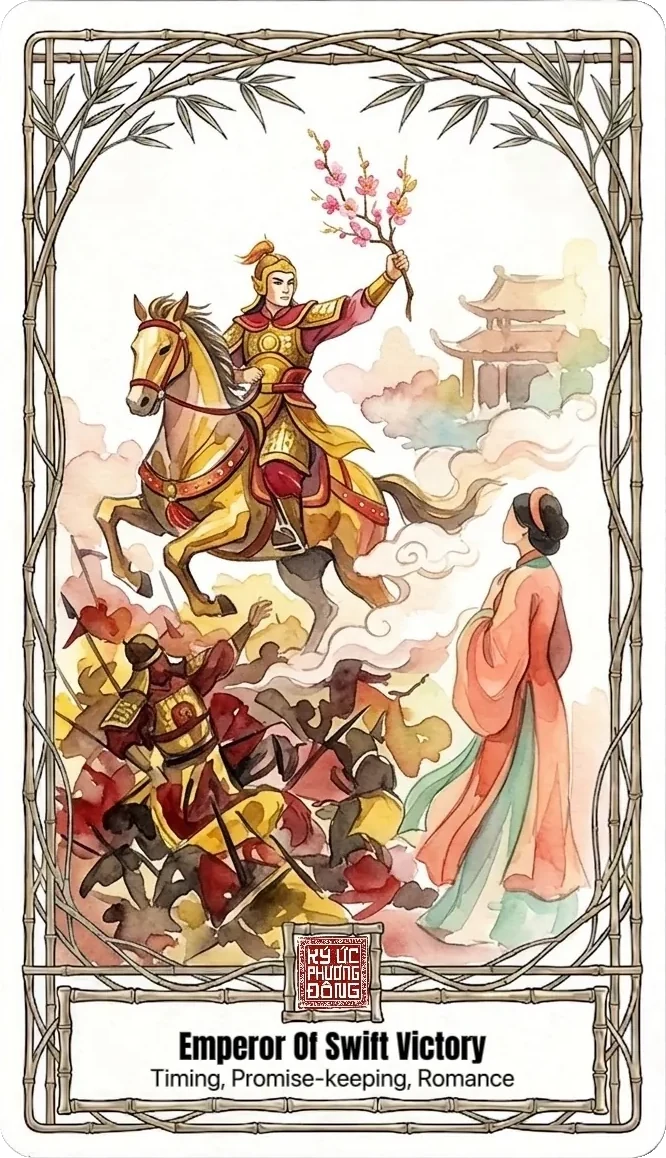
Emperor of Swift Victory
“A peasant who became emperor, won an impossible war in days, and rode home with peach blossoms for the woman he loved.”
| Vietnamese | Vua Quang Trung |
|---|---|
| Kind | Heroes & History |
| In the deck | 1 of 90 cards |
The Story
He was born plain Nguyễn Huệ, a country boy from the dusty highlands of central Vietnam, and there was nothing in his beginnings to suggest he would die an emperor. But some men are built like a storm gathering offshore — quiet, then suddenly everywhere at once. By the time he took the throne and the name Quang Trung, the whole country had learned to say his name with a sharp breath, because where Quang Trung went, things happened fast.
He moved armies the way other men moved their thoughts. While rival commanders were still drawing up plans, he had already marched. Soldiers said he could cross a country in the time it took to cook a pot of rice — that he kept his men fed and rested by tying them in teams of three to a carrying-litter, so two walked while one slept, and the whole host poured north without ever stopping. Speed was not a tactic for him. It was a weapon, as real as any sword.
His greatest hour came in the dead of winter, at the turning of the lunar new year — the Tết of the Kỷ Dậu year. A vast foreign army had swept down and occupied Thăng Long, the old capital that today we call Hà Nội. They settled in for the holiday, certain that no enemy would dare attack during the most sacred festival of the year. They were drinking and resting when Quang Trung's men appeared out of the cold like a wave that had been building for a thousand miles.
What followed was not a battle so much as an avalanche. In a handful of days — over the very nights the enemy had set aside for feasting — he shattered them, drove them out, and walked into the capital a conqueror. He had promised his soldiers they would eat their new-year meal inside Thăng Long. They ate it late, but they ate it, with the war already won. A man who keeps that kind of promise becomes a legend whether he means to or not.
And then comes the moment people remember even more tenderly than the victory. In the bombed and smoking streets of the freed capital, Quang Trung did not pause only to count his spoils. He found a branch of pink peach blossom — the flower of Tết, the flower of luck and tenderness and new beginnings — and he had it wrapped and carried south, league after league, all the way to Phú Xuân, the city we now call Huế. It was a gift for his empress, Lê Ngọc Hân, so that the moment the dust of war settled, she would hold spring in her hands.
Think of the distance. Think of the roads, still dangerous, still loud with the aftermath of fighting. And through all of it, a single fragile branch of blossom, kept alive by relay riders, because an emperor had made a quiet promise to the woman he loved and meant to keep it. He could topple citadels in a week, but the thing he refused to let slip was a flower for his wife.
He died young, with great plans unfinished, and history has argued about him ever since. But the picture that survives is this twin one: the general who turned the impossible into the done-in-days, and the husband who carried springtime a thousand miles so that victory and love could arrive on the same afternoon.