Welcome to Orime!
Choose your theme
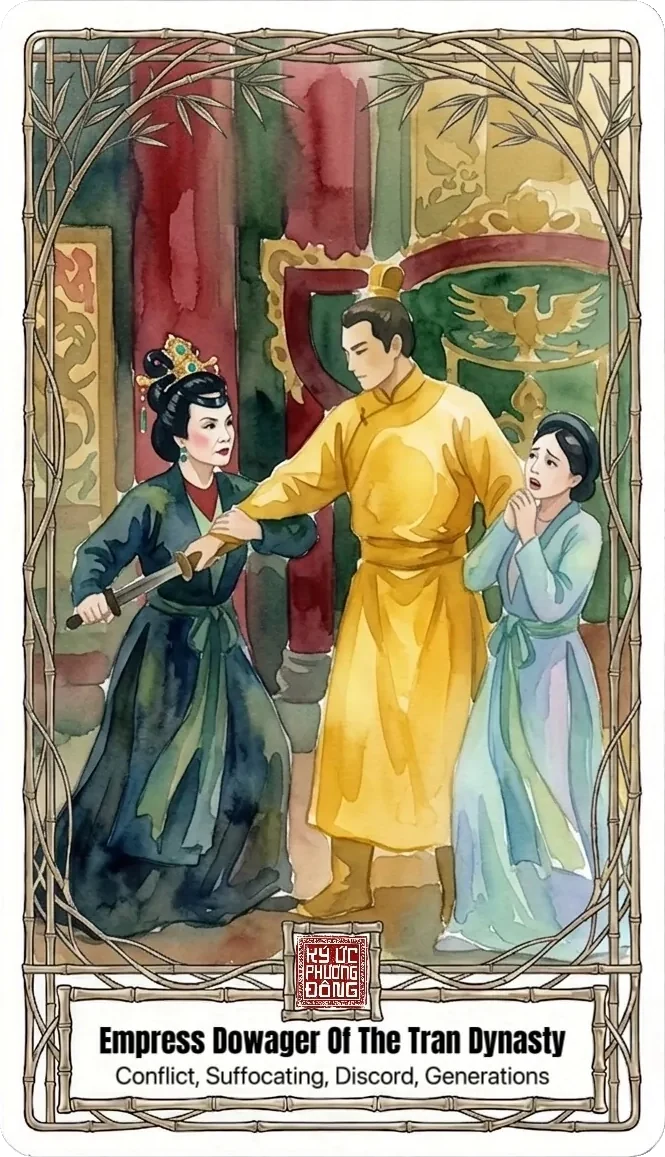
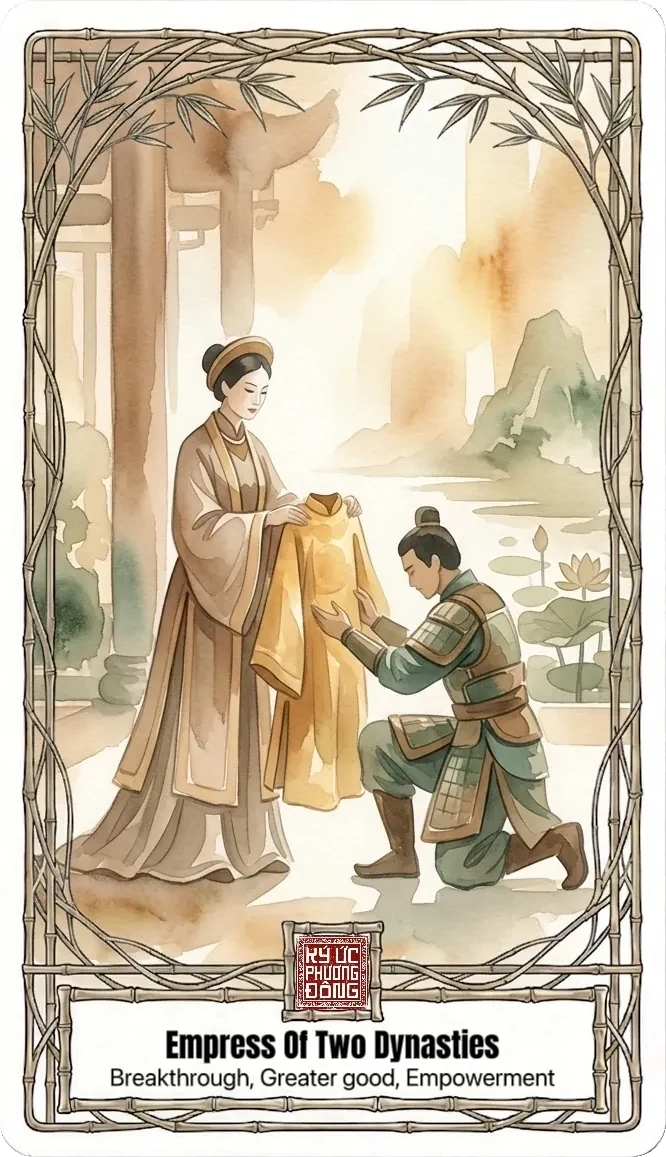
Empress Dowager Of The Tran Dynasty
“Two queens under one palace roof — a mother-in-law and a daughter-in-law whose quiet war helped topple a dynasty.”
| Vietnamese | Linh Từ Quốc Mẫu |
|---|---|
| Kind | Heroes & History |
| In the deck | 1 of 90 cards |
The Story
She was born Trần Thị Dung, a daughter of the powerful Trần clan, and she married into trouble. Her husband was Crown Prince Sảm of the failing Lý dynasty, a young man who would briefly become king while the throne crumbled beneath him. From the day she entered the palace, Trần Thị Dung walked a corridor lined with rivals — and the fiercest of them all was already waiting at the top of the stairs.
That rival was Empress Đàm (Đàm Hoàng Hậu), her mother-in-law, the reigning queen and the most feared woman at court. Đàm distrusted the Trần family from the start. She saw in this clever young bride not a daughter to be loved but a Trần agent planted at the heart of the palace — and she was not entirely wrong. The two women smiled at each other across the lacquered halls, bowed at the proper moments, and circled like cats.
What made it unbearable was that the rest of the kingdom was already on fire. Rebellions tore through the provinces. The Lý kings had grown weak, and real power was sliding, year by year, into the hands of the Trần clan and its general Trần Thủ Độ. Inside the palace, the older queen clung to the old order; the younger queen carried the future of a rising family in her blood. Their quarrel was never only about manners. It was about who would hold power when the dust settled.
There were nights the threat was naked. Court chronicles remember Empress Đàm pressing for the death of the younger woman, convinced she was a viper in the imperial bed. Trần Thị Dung survived those nights by a thread — protected, warned, spirited away by her own kin, learning the hard lesson that under one royal roof a smile can hide a knife, and a blessing can hide a sentence.
And the man caught between them? The young king himself, torn between the mother who bore him and the wife he had chosen, too gentle and too cornered to make peace between them. His hesitation cost him. While the two women fought their silent war, the throne itself slipped away. The Lý dynasty fell; the Trần dynasty rose in its place — and the bride who had nearly been killed lived to become Linh Từ Quốc Mẫu, the great Empress Dowager of the new age.
She did not fade into ceremony. When war came again — when Mongol armies later threatened the capital — it was this same woman, hardened by every palace intrigue, who organized the evacuation of the royal family and the storing of weapons, calm where stronger men panicked. The girl the old queen had wanted dead became the steady hand that helped a dynasty survive its darkest hour.
So her card holds both halves of her life: the suffocating chamber where two proud women could not yield, and the strength that grew out of surviving it.