Welcome to Orime!
Choose your theme
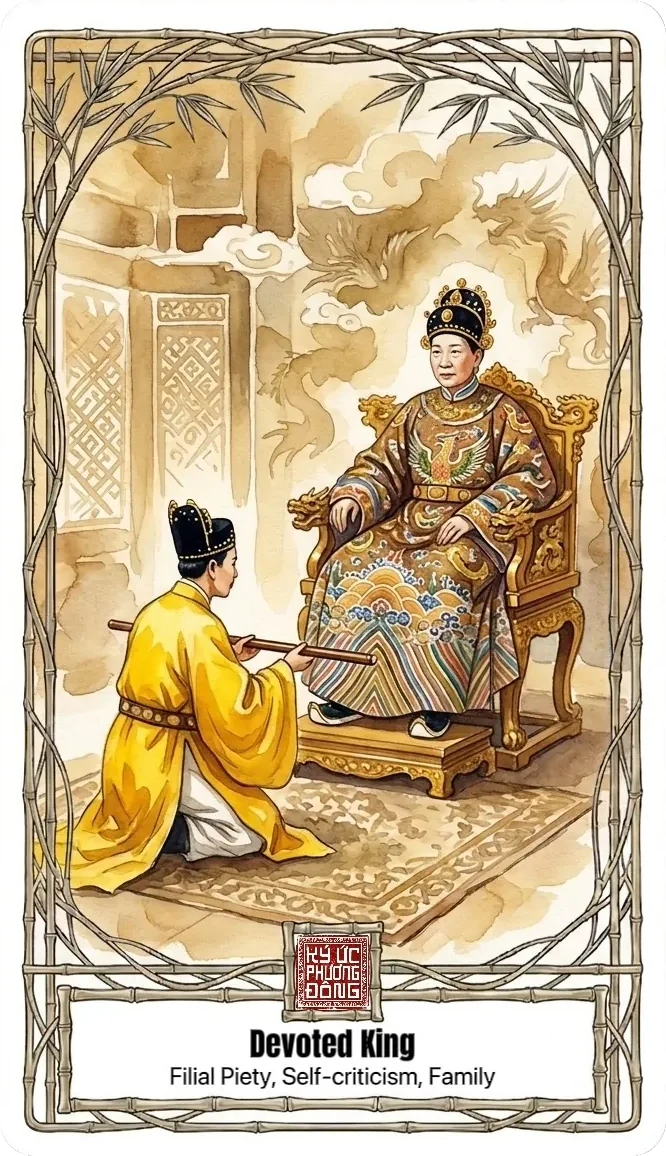
Devoted King
“An emperor knelt before his mother and held out a cane, asking to be whipped for missing her morning audience.”
| Vietnamese | Vua Tự Đức |
|---|---|
| Kind | Heroes & History |
| In the deck | 1 of 90 cards |
The Story
One morning, the rain came down hard over the imperial city of Huế, the old capital of Vietnam, and the gardens turned to silver. The young Emperor Tự Đức — fourth ruler of the Nguyễn dynasty, the last royal house of Vietnam — lost himself in the hunt and let the hours slip past. By the time he remembered, he had missed the daily visit he owed his mother, Empress Dowager Từ Dụ. To miss that visit was no small thing. In a kingdom that placed family above the throne itself, a son who neglected his mother had failed at the very root of who he was meant to be.
So the emperor did something no one expected. He did not send an apology or hide behind the thousand excuses a king has at hand. He went to his mother's chambers, and there, before the whole court, he knelt. In his two hands he held up a length of rattan cane — the rod a parent uses to correct a wayward child — and he offered it to her. Punish me, he said. I broke faith with you. Do not spare me because I wear a crown.
Imagine the silence. Here was the most powerful man in the land, lord of armies and mandarins, on his knees on the cold stone, asking an old woman to strike him. Empress Từ Dụ looked at her son for a long moment. Then she set the cane aside. A child who comes to be punished, she understood, has already corrected himself. She forgave him, and the court breathed again — and in that small scene, more than in any decree, the whole nation saw what kind of man their king was: one who dared to act and dared to answer for it.
Tự Đức ruled longer than any Nguyễn emperor, and he was a scholar to the marrow. He read the old histories and the classics until he knew them by heart, wrote poetry, and loved learning the way other kings love conquest. Yet a deep sadness ran under all his gifts, like the Water element the old people speak of — a melancholy that never quite left him. His health was frail. The world outside his walls was changing faster than his books could explain. And for all his reading, there was one verse fate would not let him write.
He had no children. Try as he might, no heir was ever born to him to carry his name or his dreams forward. In a culture where a man's line is his immortality, this was the wound that no scholarship and no crown could heal. The Vietnamese have a heavy word for it — vô hậu, to be without descendants — and the brilliant, dutiful emperor carried it all his life, grieving quietly behind the silk and the brocade.
And so his story holds two truths at once, the way real lives do. By one measure he was abundantly blessed — learned, devoted, remembered for his goodness to his mother. By another he was robbed of the one thing he wanted most. The old people called this the balance of heaven: fill a person to the brim in one place, and somewhere else there will be an empty cup. Tự Đức never got his heir. But the cane he offered his mother in the rain has outlasted his whole dynasty, and people still tell the story — which means, in a way the books would not have predicted, he left children after all.
His virtue became his lineage. Not sons, but a name that springs back to life every time someone repeats what he did that morning, and quietly wonders whether they could do the same.