Welcome to Orime!
Choose your theme
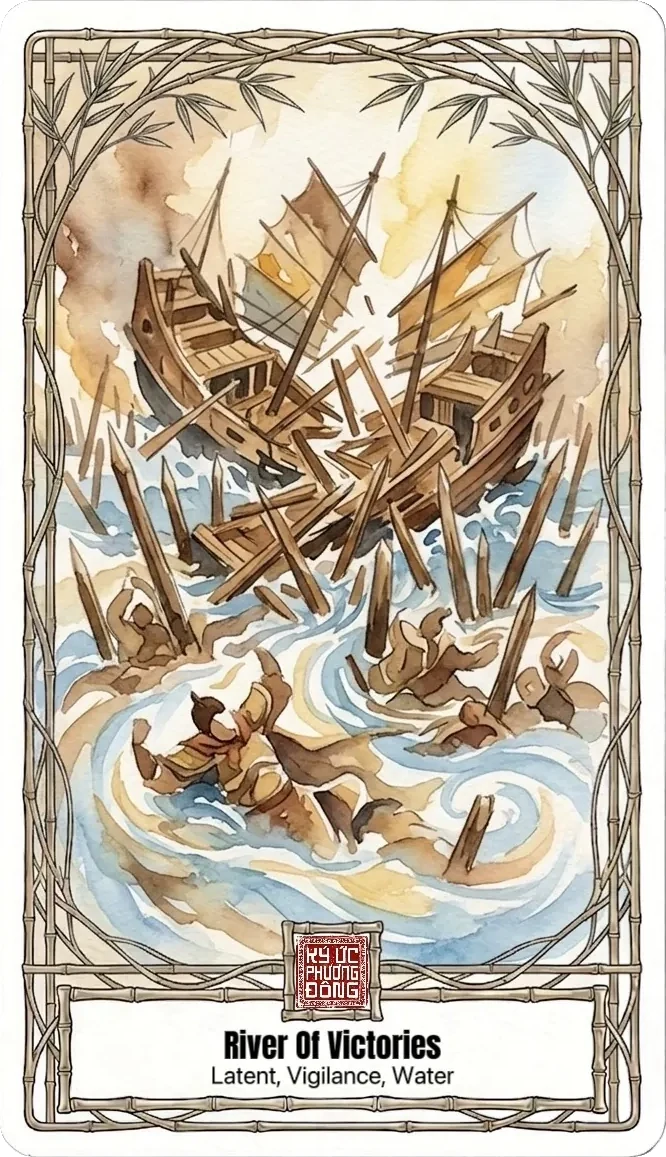
River Of Victories
“Three times an empire sailed up this quiet river to conquer Vietnam — and three times the river swallowed its fleet whole.”
| Vietnamese | Bạch Đằng Giang |
|---|---|
| Kind | Heroes & History |
| In the deck | 1 of 90 cards |
The Story
There is a river in northern Vietnam called Bạch Đằng — the White Wave River — that looks, at low tide, like nothing special at all: brown water sliding between mudflats, fishermen poling home, the sea breathing in and out twice a day. But twice a day is exactly the point. For the men who defended this country, those tides were not weather. They were a weapon.
The first to prove it was a general named Ngô Quyền. In the year 938, a fleet from the Southern Han — a Chinese kingdom to the north — came rowing up the Bạch Đằng to crush a young Vietnamese rebellion before it could become a nation. Ngô Quyền met them not with a bigger navy, which he did not have, but with an idea. In the days before the battle, his men drove hundreds of iron-tipped wooden stakes into the riverbed, hidden under the high-tide water where no helmsman could see them. Then he sent a few small boats to taunt the enemy and flee upstream — at exactly the moment the tide began to fall.
The Han fleet gave chase, full of confidence. By the time they realized the water was dropping out from under them, their heavy warships were already settling onto the stakes. Hulls split. Boats wedged fast in the mud and tipped. And then Ngô Quyền's main force swept down on the tangled, sinking enemy and finished them. That one afternoon ended a thousand years of foreign rule. Vietnam was, at last, its own.
Forty-three years later the river did it again. In 981 the great Song empire marched south, and a general named Lê Hoàn fought them on the same waters with the same patient cunning, breaking the invasion and saving the new kingdom a second time.
But the river's masterpiece came in 1288, against the most terrifying army the world had ever seen: the Mongols, the empire of Kublai Khan, who had swallowed China and ruled from the Pacific to Eastern Europe. Their fleet pushed up the Bạch Đằng expecting an easy passage home. Waiting for them was Trần Hưng Đạo, Vietnam's greatest commander, who had studied his ancestors well. He planted the stakes. He read the tide tables like scripture. He lured the Mongol ships forward with a feigned retreat, held them in place with fireboats and skirmishers, and waited — until the falling tide impaled the entire fleet on the hidden forest of spikes beneath the surface.
What followed was not a battle so much as a reckoning. Hundreds of Mongol ships burned or sank; their admirals were captured; the invasion that had terrified half the world died in the mud of a Vietnamese river. Three empires, three centuries, one quiet stretch of water — and every time, the lesson was the same. The bigger force lost. The patient mind won.
The trick was never the stakes alone. It was the marriage of three things: the right moment, the lay of the land, and men who trusted each other enough to wait for it. The stakes did nothing until the tide turned. The tide meant nothing without a general willing to hold his nerve until it did.