Welcome to Orime!
Choose your theme
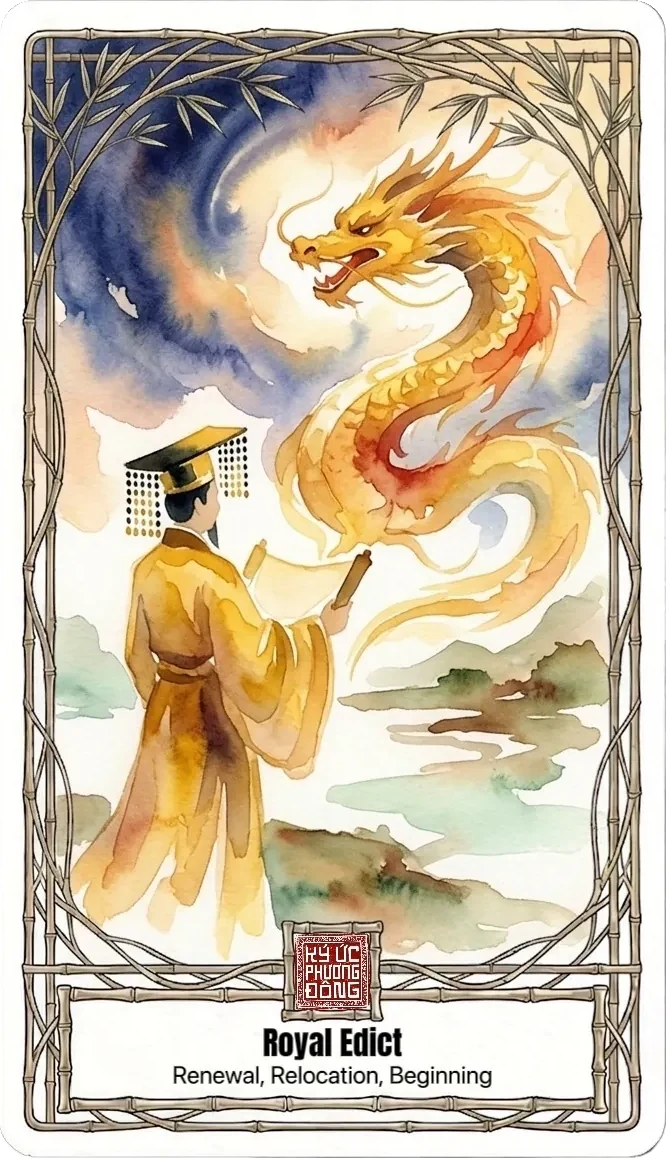
Royal Edict
“A young king looks at his cramped mountain capital, picks up his brush, and writes the letter that will move a nation.”
| Vietnamese | Chiếu Dời Đô |
|---|---|
| Kind | Heroes & History |
| In the deck | 1 of 90 cards |
The Story
In the year 1010, a new king sat in a palace ringed by limestone peaks. His name was Lý Thái Tổ — Lý Công Uẩn before the throne found him — and he had just founded a dynasty. By every rule of his age he should have been content. He had won. The crown was his. And yet, looking out at the narrow valley of Hoa Lư, the old capital tucked deep in the mountains of the north, he felt something close to claustrophobia.
Hoa Lư had served its purpose. In dangerous years, when the country was young and enemies were near, those steep walls of stone had been a gift — a fortress you didn't have to build, handed to you by the earth itself. But a fortress is a place to survive, not a place to flourish. The valley was tight. The land was hemmed in. A kingdom that wanted to grow could not keep living inside a stone box.
So the king did something rare for a ruler: he explained himself. Instead of simply issuing the order, he sat down and wrote out his reasoning for his court and his people. The document came to be called the Chiếu Dời Đô — the Edict on Moving the Capital — and it reads less like a command than like a man thinking aloud, generously, in front of everyone he governs.
He had his eye on a place to the north called Đại La, sitting where a great river bends through open country — the ground we now call Thăng Long, and after that, Hà Nội. He described it the way you'd describe a home you'd already fallen in love with: flat and spacious, watered by rivers, sheltered yet open, the meeting point of the four directions. It was, he argued, the natural heart of the land — the kind of ground where a capital could stand not for a reign or two, but for ten thousand generations.
Legend wraps a touch of wonder around the move. As the royal boats came up the river toward Đại La, people said a golden dragon rose from the water and climbed into the sky above the new capital — and so the king renamed the place Thăng Long, the City of the Soaring Dragon. Whether you believe in the dragon or not, everyone could see the truth it stood for: the country was lifting off, leaving the narrow valley behind for the open sky.
And he was right. The plain that had frightened cautious advisors with its lack of stone walls became one of the great enduring capitals of Asia — a city that has now stood for more than a thousand years, through invasions, dynasties, and centuries, exactly as a young king with a brush had promised. He had traded the safety of the mountains for the future of the plains, and history proved his nerve.
What makes the edict remarkable isn't the conquest behind it — it's the vision in front of it. Lý Thái Tổ wasn't fleeing danger when he moved. He was already safe. He moved because safe wasn't the same as right, and because he could see, with that strange clear-sightedness great founders sometimes have, that the place that protected you yesterday can quietly become the place that holds you back.