Welcome to Orime!
Choose your theme
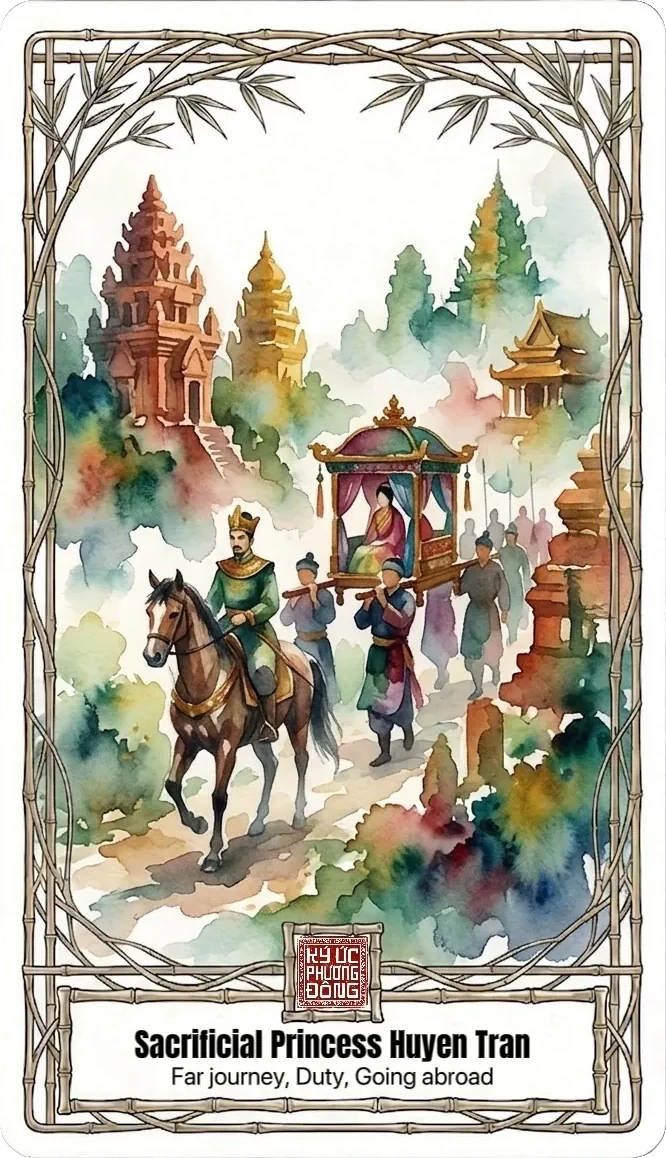
Sacrificial Princess Huyen Tran
“A princess traded her own heart for two provinces — and sailed away from everything she loved to win them.”
| Vietnamese | Huyền Trân Công Chúa |
|---|---|
| Kind | Heroes & History |
| In the deck | 1 of 90 cards |
The Story
She was born into the brightest court in the land. Huyền Trân Công Chúa — Princess Huyền Trân — was a daughter of the Trần dynasty, raised inside the walls of Thăng Long, the imperial capital that would one day grow into Hanoi. Picture lacquered halls and lotus ponds, scholars and silk, a city humming with the confidence of a kingdom that had just thrown back the Mongols. This was the only world she knew, and she had every reason to expect she would live and die inside it.
Then politics came knocking, the way it always does for princesses. To the south lay Champa, a powerful, sea-facing kingdom with a culture all its own — different gods, a different language, customs that would have felt like another planet to a girl raised in the Trần court. Its king offered the Đại Việt throne a deal that no ruler could lightly refuse: a marriage alliance, and as the bride-price, two whole prefectures — the lands of Ô and Lý, a long stretch of coast and rice country that would push the southern border outward and bind the two kingdoms together in peace.
There was only one thing the king of Champa wanted in return. He wanted Huyền Trân.
Imagine being told that your wedding was no longer about love, or even about your own life, but about a map. That your single 'yes' would either gain a nation two provinces or cost it a peace. Court records remember the grumbling — many at home thought it shameful to send a Trần princess away to a foreign court. But Huyền Trân understood the arithmetic better than the men who debated her. The choice was hers to carry, and she carried it.
So she went. She left Thăng Long behind — the ponds, the festivals, the family she would likely never see again — and traveled a thousand miles of land and water to a kingdom where she could not speak the language, could not read the prayers, could not lean on a single familiar face. She crossed the sea to become not a queen on a pedestal but a daughter-in-law in someone else's house, learning new manners one careful day at a time. And the two prefectures of Ô and Lý passed quietly into Đại Việt, where they remain part of central Vietnam to this day. The land her people walk on now, she bought with her own life.
History did not give her an easy ending — sacrifices like hers rarely come wrapped in roses. But it gave her something more lasting than comfort. Centuries later her name is still spoken with a catch in the throat, half sorrow and half awe, the kind of respect a country reserves for someone who gave up her happiness so that everyone else could keep theirs.