Welcome to Orime!
Choose your theme
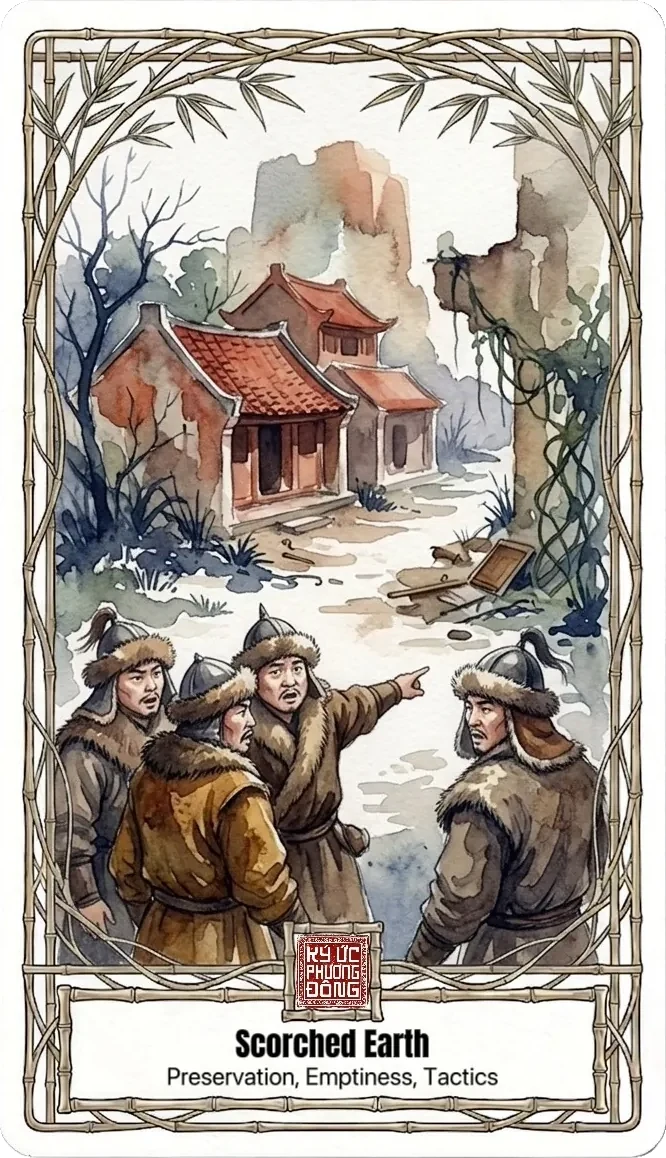
Scorched Earth
“An empire's greatest army marched into a capital — and found nothing but silence, dust, and locked gates.”
| Vietnamese | Vườn Không Nhà Trống |
|---|---|
| Kind | Heroes & History |
| In the deck | 1 of 90 cards |
The Story
The Mongol cavalry had never lost. They had ridden across half the known world, toppling cities from China to the gates of Europe, and now they turned south toward a small, stubborn kingdom on the edge of the sea: Đại Việt, the land that would one day be called Vietnam. Three times across the thirteenth century they came, and three times they expected the same thing — a rich capital to plunder, granaries to empty, a frightened people to scatter before their horses.
What they did not expect was a king who refused to fight them where they were strong. The Trần dynasty rulers and their brilliant commander knew the cold arithmetic of war. The Mongols were a storm: terrifying, fast, and utterly dependent on what they could seize along the way. An army that lives by plunder must keep plundering, or it starves. So the Trần court asked itself a hard question — what if there were nothing to seize?
The strategy they chose has a name that still rings through Vietnamese memory: Vườn Không Nhà Trống — "empty gardens, deserted homes." As the invaders thundered toward the imperial capital of Thăng Long (old Hanoi), the order went out across the countryside. Pack what you can carry. Drive the buffalo into the hills. Hide or burn every last grain of rice. Fill in the wells. Take the children, the elders, the ancestral tablets — and vanish into the forests and river deltas.
When the Mongol vanguard finally smashed through the gates of Thăng Long, swords drawn, hungry for the prize of a great city, they rode into a ghost. The streets were swept clean and silent. The houses stood open and empty. There was no king to capture, no treasury to loot, no peasant to enslave, not a single bowl of rice to feed a horse or a man. They had won the city and conquered nothing at all.
And there the great machine of conquest began to grind itself to pieces. Days passed, then weeks. The invaders' supply lines stretched thin across hostile, emptied land. Hunger crept into the camps. Tropical heat and sickness did what no battlefield could. Out of the trees and the marshes came swift Vietnamese raids — striking the foragers, the stragglers, the exhausted — then melting away before a real fight could form. The Mongols' very strength, their size and appetite, had become a weight around their necks.
By the time the weakened army turned to retreat, the Trần forces were waiting — rested, fed, and patient. The same emptiness that had let the invaders in now closed around them like a fist. Three invasions, three defeats. The mightiest army on earth had been beaten not by a bigger sword, but by a kingdom that chose, on purpose, to have nothing worth taking.
The people came home afterward to scorched fields and stripped houses. They had given up almost everything they owned — and kept the only things that could not be carried off: their freedom, their land, and themselves.