Welcome to Orime!
Choose your theme
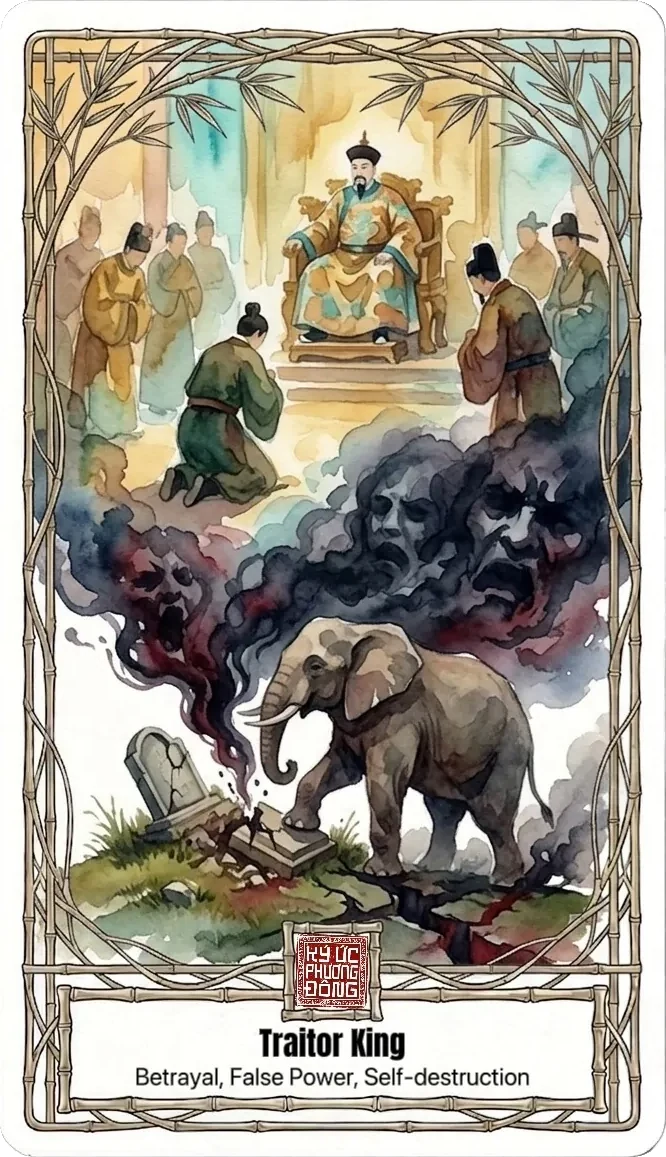
Traitor King
“He opened his own country's gates to a foreign army, and lost everything but his name in the history books.”
| Vietnamese | Vua Lê Chiêu Thống |
|---|---|
| Kind | Heroes & History |
| In the deck | 1 of 90 cards |
The Story
The last king of the Lê Trung Hưng dynasty — Lê Chiêu Thống — did not begin as a villain. He inherited a throne that was already cracking beneath him: a court hollowed out by warring noble clans, a treasury bled dry, and rivals circling his weakening grip on the north of Đại Việt, the old name for Vietnam. He wanted, more than anything, to keep his crown. That ordinary wish is where the tragedy starts.
When his rivals rose against him and drove him from the capital, the young king made a choice that would brand him forever. Rather than rally his own people, he looked across the northern border to the Qing dynasty — the vast empire of China — and begged them for soldiers. Send your armies, he pleaded, and put me back on my throne. The Qing emperor was glad to oblige. Why protect one foreign king out of kindness, when an invitation could be turned into a conquest?
So a great Qing host marched south, banners and spears flooding the roads, and Lê Chiêu Thống rode among them — not as a liberator returning home, but as the man who had unlocked the door. His people watched their fields and villages overrun by an army he had personally summoned. The Vietnamese remember this with two unforgiving phrases: he had "invited a serpent to devour his own flock," and "ushered an elephant in to trample his ancestors' graves." Both mean the same cold thing — he brought the destroyer in with his own hands.
The borrowed power did not save him. To the Qing, he was never a king to be restored; he was a convenient excuse, a puppet to prop up while they took what they wanted. He had traded away the one thing a ruler cannot buy back — the loyalty of his own people — and received in return only the hollow title of a king with no kingdom, no army of his own, and no honor left.
The invasion ended in disaster for him. The foreign army was broken and thrown back out of the land, and Lê Chiêu Thống fled north with the retreating troops, an exile in the very empire he had trusted. He never came home. He died far from the ancestral soil he had betrayed, his dynasty extinguished, his name fixed in memory not for what he ruled but for what he surrendered.
And here is the bitter heart of his story: he did not fall because he was weak in battle or unlucky in war. He fell the moment he decided that holding his throne mattered more than the people and the land beneath it. Everything after that — the foreign soldiers, the trampled graves, the lonely death in exile — flowed from that single inward turn, when a man chose himself over everything that had made him.