Welcome to Orime!
Choose your theme
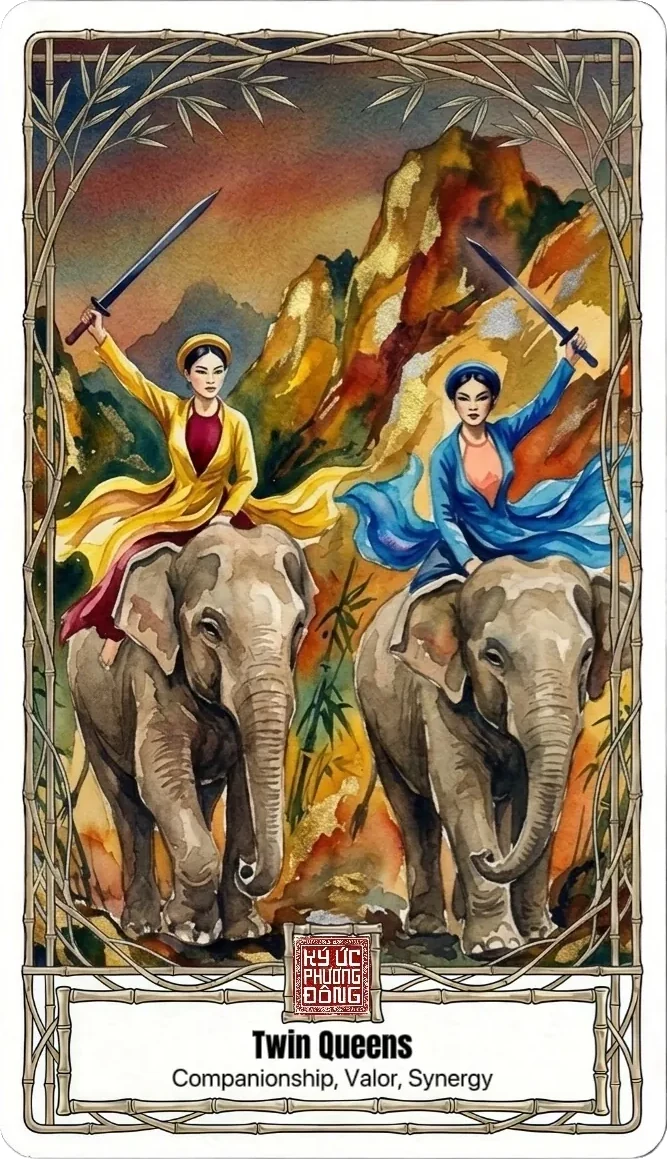
Twin Queens
“Two sisters climbed onto war-elephants and dared an empire to stop them — and for three years it couldn't.”
| Vietnamese | Hai Bà Trưng |
|---|---|
| Kind | Heroes & History |
| In the deck | 1 of 90 cards |
The Story
Picture two young women of noble blood in the green river-country of ancient Vietnam, raised side by side in a land that no longer belonged to its own people. Their names were Trưng Trắc and Trưng Nhị — the elder fierce and steady, the younger quick and bright — and they grew up under the heavy hand of governors sent down from the north, who taxed the rice, seized the salt, and ruled as if the land and everyone on it were theirs to spend.
Trưng Trắc, the elder, married a man as proud and unbending as she was. When he spoke too loudly against the cruelty of the foreign governor, the governor did the thing that tyrants do when they cannot win an argument: he had him killed, meaning to frighten the rest into silence. He had badly misjudged the woman he was trying to frighten.
Grief can fold a person inward, or it can light a fire that spreads. In Trưng Trắc it became a torch. She did not weep quietly and disappear. She went out among the villages and the chieftains and the angry farmers, and her sister went with her — never one queen and her helper, but two sisters shoulder to shoulder, finishing each other's sentences, dividing the work of a rebellion between them. People who would not have followed one stranger followed two sisters who plainly trusted each other with their lives.
When the banner of revolt finally went up, the legend says the sisters rode to war on the backs of elephants, leading not a tidy professional army but a flood of ordinary people who had simply had enough. Town after town opened to them. The governor who had murdered one husband and underestimated two sisters fled north for his life. In a span that must have felt like a single held breath, the foreign rule that had pressed on the land for generations cracked and gave way.
And then — this is the astonishing part — the people made Trưng Trắc their queen, with her sister beside her as co-ruler. For about three years the two sisters governed the land they had freed, lowering the cruel taxes, restoring what had been taken, ruling together as they had fought together. It was one of the first times in that long history that the country stood on its own feet, and it was two women who put it there.
The empire they had embarrassed did not forget. It gathered its strength, sent down a hardened general with a real army, and came back. The sisters fought, and the records that survive say they fought to the very end rather than kneel again. But the point of their story was never that they won forever — almost no one wins forever. The point is that two ordinary-born women looked at an empire and decided it could be beaten, and proved, for three shining years, that they were right.
Ever since, the Vietnamese have honored them simply as Hai Bà Trưng — the Two Lady Trưng — with temples, with festivals, with streets in every city bearing their name. They are remembered not as a single hero but always as a pair, because that was the secret of them: not one will, but two wills braided into something an empire could not pull apart.